
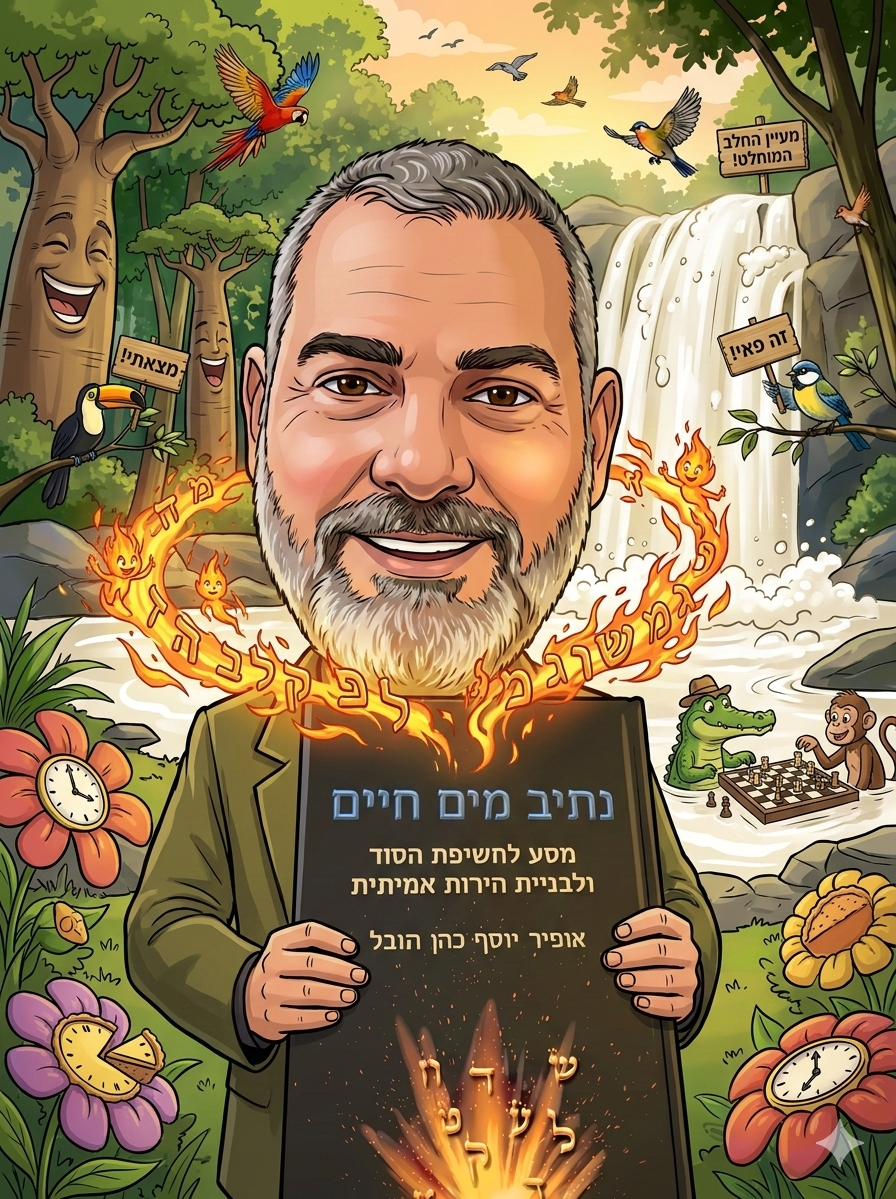
By: Ofir Yossef Cohen Touval | Path of Living Waters
The Diagnosis: The "Noise" Disease of Our Generation
Ours is the generation of redemption, the last generation, according to Kabbalah. The holy Zohar (the foundational book of Jewish mysticism) calls this generation "Ikveta DeMeshicha" – "the footsteps (literally, the heels) of the Messiah."
The term "the heels of the Messiah" hints at a state in which the lights are found in the "heels" – the lowest, most external place in the human body.
When light is in the heel, it must be violent, strong and jarring for us to feel it, for us to respond to it.
- The problem: the soul has become used to the "electric shock" of excitement.
- The result: whatever does not shout, frighten or threaten does not exist for us. Whatever does not shake us – bores us.
- The price: we lose the ability to enjoy "simple light." We become "addicts of stimulation," and our inner vessel cracks under the force of the flow.
"A still, small voice" (1 Kings 19:12 – the way the Divine revealed itself to the prophet Elijah, not in the wind, the earthquake or the fire, but in a gentle quiet) is not only a description of revelation but a condition for revelation. Where there is noise, there is no revelation of the Divine in the soul.
The Kabbalistic Model: Between "Red" and "White"
In the system of the Sefirot (the ten divine attributes through which, according to Kabbalah, the world and the soul are structured), excitement belongs to the side of unsweetened Gevurah (strength, judgment and restriction – symbolized by the color red). Stillness belongs to the Sefirah of Chochmah (wisdom, called "Ko'ach Mah" – "the power of 'what?'," a state of humble self-nullification) and to the Sefirah of Binah (understanding, described as "the river that flows out of Eden"), symbolized by white.
| The culture of excitement (red) | The culture of stillness (living waters) |
|---|---|
| Movement: twitching, jumping, "my field is moving" | Movement: slow flow, deepening |
| Central organ: the eyes (seeing everything) | Central organ: the ears (listening to inwardness) |
| Symptom: the need for a "wow" | Symptom: joy in what "is" |
| Result: the shattering of vessels (burnout) | Result: the building of vessels (growth) |
The Repair: "Chewing the Cud" as a Spiritual Technology
The pig is non-kosher because it does not chew its cud (Leviticus 11:7). In the soul, chewing the cud is the ability to take a piece of information or a feeling and process it again and again until it becomes "blood of our flesh" – truly part of us.
Weaning ourselves from excitement begins with "digestion":
- Restraining the "swallowing": not taking in a new stimulus before the previous one has been digested.
- Delaying the response: excitement lives on immediacy (a like, a reaction, a share). Stillness lives on waiting.
Three Stages for Restoring Stillness (According to the Baal Shem Tov)
The Baal Shem Tov (Rabbi Israel ben Eliezer, the 18th-century founder of the Chassidic movement) gave a formula for dealing with any inner struggle: Hachna'ah, Havdalah, Hamtakah – submission, separation, sweetening. Let us apply it to weaning ourselves from excitement:
1. Submission (Hachna'ah): "Fasting from Movement"
It is impossible to reach stillness without admitting that we are addicted.
- The action: setting times of "complete disconnection." Not as a punishment, but as oxygen.
- The intention: "I do not have to know everything right now." Submission before the world's flooding stream.
2. Separation (Havdalah): Building a "Fence Around the Vineyard"
Understanding that there is an abyss of difference between information and wisdom.
- The action: filtering sources. If a source of information (news, social media) leaves you tense, confused or "shaken," it is a red Klipah (a "husk" – in Kabbalah, a shell that conceals and draws away holy light).
- The intention: I am protecting my "vineyard" (the soul) from the "pig" (the external gnawing).
3. Sweetening (Hamtakah): Finding Vitality in the Inner Point
This is the stage at which stillness stops being "boring" and becomes "fulfilling."
- The action: Hitbonenut (Jewish contemplative meditation) on one small detail. Studying the depth of a single verse for an hour. Listening to a melody without words.
- The intention: to discover that the Divine is found within things, not in their noisy wrapping.
A Practical Exercise in the Spirit of "Living Waters"
To restore stillness, we need to build "Mikva'ot of time" (a Mikveh is a ritual immersion pool – here, small pools of time in which the soul can immerse and be renewed) throughout the day:
- The moment of waking: five minutes without devices. Only "Modeh Ani" (the short prayer of thanks said on waking). Connecting to the channel of life before the world rushes in.
- The blessing over food / eating: conscious eating is the direct repair of the "pig's gnawing." Eat without a screen. Feel the taste. Chew the cud.
- In between: every time you feel the urge to check "what's happening in the world," take three deep breaths and ask: "What is happening inside me right now?"
Shabbat as a Model of Weaning
Shabbat is called "a taste of the World to Come" because it is the place where excitement stops and delight begins.
Excitement is external, fast and wearing.
Delight (Oneg) is internal, quiet and growing.
Our work is to bring "the taste of Shabbat" into the weekdays – to stop running after the "wow" and begin living the "Hineni" ("Here I am" – the answer of Abraham, Moses and the prophets when called: full presence).
In Closing
Stillness is not the absence of sound, but the presence of listening.
Whoever weans himself from excitement discovers that every simple moment is a spring of living waters.
Enjoyed it? ❤️ Share it so others can read it too:
📖 The book in English (Amazon) | 🎥 YouTube | 💬 Daily WhatsApp updates (Hebrew) | 🎧 Spotify | 👍 Facebook | ✍️ Blog
 📖 The book "Path of Living Waters"
The soul is thirsty. The path begins within – clinical psychology and Kabbalah in one language.
About the book, free sample & purchase ▾
Someone says one word, in one tone, and something inside you explodes. Who is really holding the remote control to your buttons?
A journey of healing that unites clinical psychology with the wisdom of Kabbalah and Chassidut – for anyone who feels that pain is a letter from the soul, asking us to return to our source. Written by Ofir Yossef Cohen Touval, clinical psychologist, out of more than three decades of therapeutic work in Israel and Germany.