
By: Ofir Yossef Cohen Touval | Path of Living Waters
Holocaust Remembrance Day (Yom HaShoah, observed in Israel every spring, when the whole country stops for a siren in memory of the six million Jews murdered by the Nazis) brings up mixed memories in me.
As a child and as a teenager, my memory of the Holocaust was mainly ceremonial – orderly, official, but distant. We stood in school with our heads bowed and read out the names of people who had been murdered. Many names, unknown faces, stories that were never told. There was sadness, but there was no understanding. There was silence, but there was no presence.
The visit to Yad Vashem (Israel's national Holocaust memorial and museum in Jerusalem) also left a certain impression on me, but in the reality of a noisy class, something deeper did not manage to get through. The Holocaust remained a concept for me – not an experience. History – not reality.
Only years later, when I set out on a trip after the army and arrived in Germany, did I meet a completely different reality: well-kept houses, quiet streets, polite people. Nothing in the space reflected the horror I knew had happened there. This gap – between knowing and experiencing – created a sense of disconnection in me. How could a place like this have been the stage for one of the darkest events in the history of humanity?
Understanding did not come through texts, and not through landscapes – but through human beings.
During my master's studies in psychology, I chose to research the effects of the Holocaust on the second and third generations of Jews living in Germany. Through interviews with families, through personal stories, through pain that was not always put into words – I began to see how a historical trauma becomes a psychological structure. How a memory that is not spoken goes on living, being passed on, and having an effect.
The moment it truly became personal was when I sat down to interview my own grandmother.
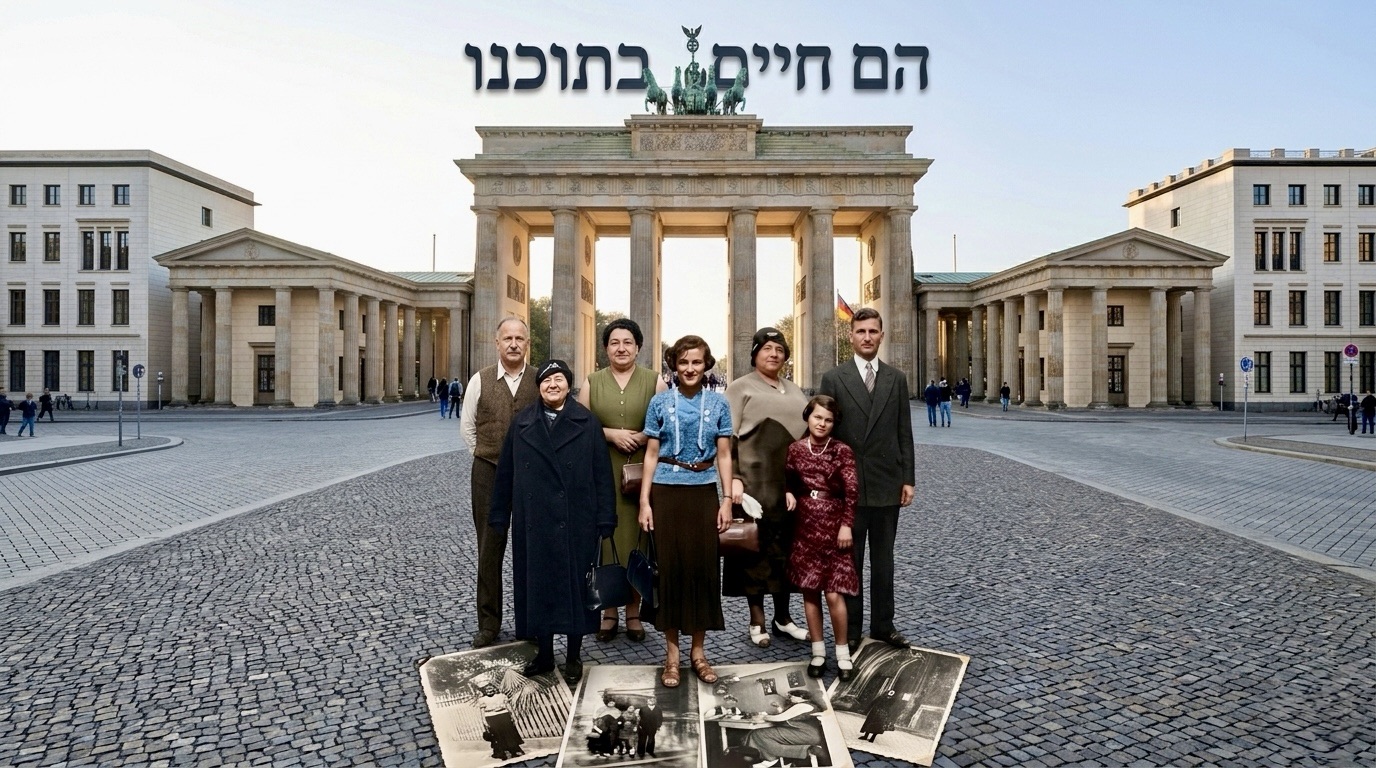
She was born in Berlin, and managed to escape Germany before the war broke out. All the members of her family who stayed there – were murdered. It was no longer about numbers. No longer about names on a list. It was about my family.
There, the distance collapsed.
The Holocaust stopped being a "historical event" and became part of identity.
And from there a wider understanding opened up: the Holocaust is not only a private memory, and not even only a national memory – it is a layer of consciousness that continues to act.
We see it in thought patterns, in a sense of existential threat, in heightened sensitivity to danger, in a need for control, and sometimes also in a deep difficulty trusting. Even someone who did not live through the Holocaust carries its echo within them. It lives in the collective consciousness of an entire people.
But when we look at this process through the lens of Kabbalah, a further layer is revealed.
Kabbalah teaches that the people of Israel are not only a collection of individuals, but one collective soul – a single spiritual reality spread out across generations. The Arizal (Rabbi Isaac Luria, the great 16th-century Kabbalist of Safed) teaches that all the souls of Israel are bound to one another, clothed within one another, and continue processes that were not completed. Therefore, a trauma of such magnitude does not stay "there" – it is engraved into the collective vessel of the nation.
In Kabbalistic terms, the Holocaust can be seen as a state of extreme concealment of the light – a deep hester panim ("hiding of the Face," the biblical expression for times when God seems absent), in which reality is experienced as disconnection, as lack of meaning, as absolute darkness.
But precisely out of the depth of concealment, a process of building begins.
The establishment of the State of Israel is not only a historical response to events – but a renewed appearance of a vessel.
After nearly two thousand years of exile, in which the light was preserved mainly on the inside – in study, in tradition, in identity – without a real national vessel able to hold it, a change takes place: a return to a reality of a vessel.
(In Kabbalah, "light" is the spiritual content and abundance, and the "vessel" is the form that can receive and hold it. A people, a land and a language are such a vessel on the collective level.)
A state, a language, a land – these are not only external components, but an opportunity to clothe light in reality.
But here the depth of the challenge is revealed:
The vessel has been given – but it is not yet repaired.
And here the words of the Arizal about ikveta di-meshicha – "the footsteps of the Messiah," the final era before redemption – come in.
The Arizal teaches that the main work in the last generations is the tikkun (repair) of Malchut ("Kingship") – the all-encompassing vessel, the will to receive in its fullness. Malchut, which was in a state of fall and concealment, begins to go through a process of clarification. This is not a quiet or orderly process – but one full of conflicts, crises and extreme movements. It is precisely through complex reality that the vessel is clarified and built.
And within this process, the words of Baal HaSulam (Rabbi Yehuda Ashlag, the 20th-century Kabbalist) about "the last generation" take on a very practical meaning.
He explains that humanity has reached the exhaustion of the egoistic form of existence. The will to receive for oneself has built a world of progress, but also of separation, tension and crisis. And so what is required is a leap of consciousness – a passage from a form of existence of receiving for oneself alone, to a form of existence of bestowal, mutual responsibility (arvut), and shared accountability.
This is not merely a moral idea – but an existential condition.
For only a vessel that acts out of connection is able to hold the light that is drawing near to be revealed.
And here all the layers connect:
The Holocaust – as deep concealment and a break in the vessel.
The generation that followed – as the bearer of the memory and the trauma.
The establishment of the State – as the renewed appearance of the vessel.
And our generation – as the one required to actually repair this vessel.
This is not only history.
It is a process.
And the question that remains open – perhaps the most important question – is very personal:
How am I taking part in this tikkun?
Am I acting out of fear, separation and defensiveness – and so continuing the break?
Or am I building, within myself and around me, a consciousness of connection, responsibility and bestowal – and so becoming a partner in building the vessel?
For in the end, the tikkun of a collective soul does not happen on an abstract level.
It happens through the small choices of each person, every new day.
And there – precisely there – memory turns from a consciousness of the past into a force that gives birth to a future.
📖 The book in English (Amazon) | 🎥 YouTube | ✍️ Blog
 📖 The book "Path of Living Waters"
The soul is thirsty. The path begins within – clinical psychology and Kabbalah in one language.
About the book, free sample & purchase ▾
Someone says one word, in one tone, and something inside you explodes. Who is really holding the remote control to your buttons?
A journey of healing that unites clinical psychology with the wisdom of Kabbalah and Chassidut – for anyone who feels that pain is a letter from the soul, asking us to return to our source. Written by Ofir Yossef Cohen Touval, clinical psychologist, out of more than three decades of therapeutic work in Israel and Germany.