
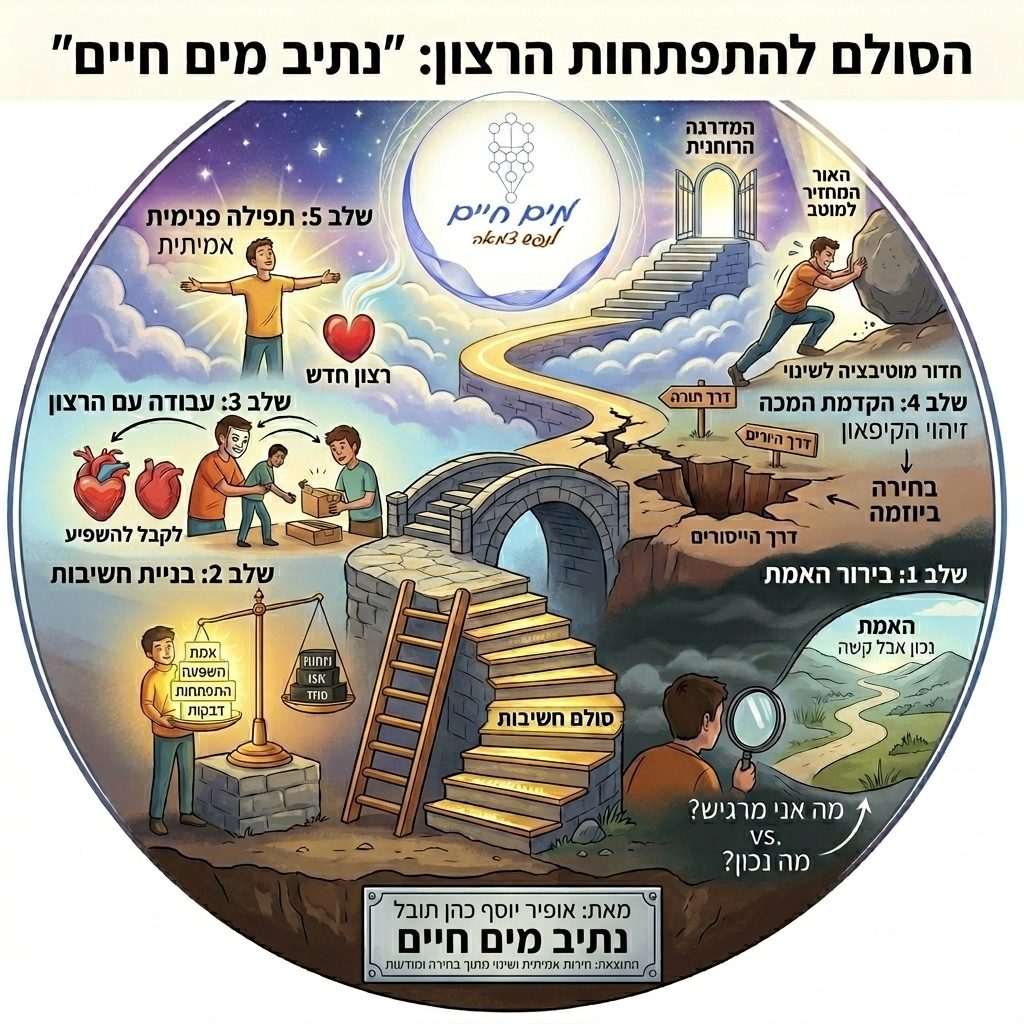
By: Ofir Yossef Cohen Touval | Path of Living Waters
The human being is built as a will to receive. This is the foundation that both the Kabbalists and psychology speak about, each in its own language. This will strives for one thing: to preserve what exists. Not because it is "good," but because it is "familiar." And the brain translates the familiar as safe.
Here a very precise mechanism comes into play: our brain is not looking for happiness – it is looking for stability. Even if that stability includes pain. That is why a person can remain for years in a situation that is not good for them – a suffocating relationship, harmful habits, thought patterns that diminish them – simply because it is the state they know. Change, by contrast, is perceived as a threat. It is unknown, and therefore dangerous.
If we look at this more deeply, in inner language: the vessel (the will) prefers a small, familiar light over a great, unknown light. It holds on to what it has, even if it is limited.
And so, as long as the pain is bearable – a person does not move.
Only when a gap opens that is large enough between what is and what can be borne does a "breaking" occur.
It can be a health crisis, an emotional collapse, a breakdown in a relationship, a loss, or even a feeling of deep emptiness. At that moment something interesting happens: the fear of staying in the same state becomes greater than the fear of change.
And that is the moment of birth.
The Arizal and the Zohar describe this as the pattern of all creation: there is no renewal without breaking. There is no new vessel without dismantling the old form. What we experience as "coercion" or "crisis" is really a spiritual pressure that seeks to expand the vessel.
In hindsight, when we look back, we are grateful for it – because by then we are already past the expansion. We already have a larger vessel, a wider consciousness, an ability to contain light we could not contain before. That is why it feels like "it did me good."
But in real time – it feels like loss.
To sharpen it even further:
Change is not forced on us – it is invited through the gap between who we are and who we could be.
The real question is not why we don't change, but how to move from change out of pain – to change out of awareness.
And here the deep work begins.
When a person begins to recognize their patterns before they collapse, when they are willing to "shed a form" even without something breaking from outside, they move from the level of development through coercion to the level of choice.
This is already the work of consciousness.
It is the ability to agree to uncertainty, to agree to lose an old identity, to agree to be for a moment "without form" – in order to be born again from a higher place.
Change through pain is "the path of suffering" (derech yissurim). Baal HaSulam sets another path against it – precise, systematic and no less deep: "the path of Torah," or in more inner words – change out of grasping the truth and repairing the will.
If we distill his words, we see that this is not about a one-time decision to change, but about building an inner system that enables change even before reality forces you.
The first stage is clarifying the truth.
A person must begin to see reality as it truly is, not as the will to receive paints it. Baal HaSulam speaks of this as a passage from "falsehood" to "truth."
Falsehood is what is comfortable for me now, what serves the ego. Truth is what advances me toward devekut (cleaving), toward equivalence of form with the light – meaning toward the ability to bestow, to give, to go beyond myself.
This is not a simple process, because it requires a person to stop automatically believing their feelings and thoughts. Instead of asking "what do I feel," they begin to ask "what is right."
The second stage is building importance.
Baal HaSulam emphasizes again and again: a person moves only according to importance. If spirituality, truth, bestowal are not more important to them than comfort, they will not move. So the work is not to fight yourself, but to increase the importance of the goal.
How is this done?
The right study, connection to an environment that speaks this language, returning to deep ideas until they become an inner reality. It is not enough to understand – one must be moved by the truth.
The third stage is working with the will, not against it.
Baal HaSulam does not seek to cancel the will to receive – but to repair it. That is, to take the same force that draws me toward comfort and begin to direct it elsewhere. Instead of receiving for myself – learning to enjoy influencing, giving, developing.
At first it is artificial. A person "acts out" giving. But little by little, through action, the will changes too. This is one of the deepest principles: action builds the vessel.
The fourth stage is getting ahead of the blow.
This is a more advanced stage. A person learns to recognize the places where they are about to "get stuck," before life breaks them. They feel the freezing, the resistance, and choose to move there – on their own initiative.
And here the real transition happens:
They no longer wait for pain in order to change.
The fifth stage is inner prayer – asking for a change of the will.
For in the end, a person discovers that they cannot truly change themselves alone. They can create conditions, but the change itself – the change of the will – comes from above.
Baal HaSulam speaks of "the light that returns a person to the good." The light does not come because of suffering – but because of the right longing.
And this is the deep difference:
On the path of suffering – pain pushes you.
On the path of Torah – the attraction to truth pulls you.
If we want to put it simply:
To change willingly, you need to build a new will.
And this is done through:
- clarifying the truth
- increasing importance and purposeful action
- early recognition and inner request.
At the end of the process, a person does not change because they have no choice – they change because they no longer want to stay in the old place.
And that is true freedom.
Ask yourself the right questions:
- Where in my life right now am I holding on to the familiar only because it is "safe," even though it has long stopped making me grow?
- If I were acting out of what is right and not only out of what is comfortable, what would be the first step I would take tomorrow morning?
- Am I waiting for a "breaking" (a crisis) in order to move, or am I willing to agree to uncertainty right now in order to grow?
📖 The book in English (Amazon) | 🎥 YouTube | ✍️ Blog
 📖 The book "Path of Living Waters"
The soul is thirsty. The path begins within – clinical psychology and Kabbalah in one language.
About the book, free sample & purchase ▾
Someone says one word, in one tone, and something inside you explodes. Who is really holding the remote control to your buttons?
A journey of healing that unites clinical psychology with the wisdom of Kabbalah and Chassidut – for anyone who feels that pain is a letter from the soul, asking us to return to our source. Written by Ofir Yossef Cohen Touval, clinical psychologist, out of more than three decades of therapeutic work in Israel and Germany.