
An Article for Shabbat Parashat Chayei Sarah — A Response to Prof. Kate Litvak · Ofir Yossef Cohen Touval – Path of Living Waters
Nov 6, 2026 · @Ofir Cohen Touval
Opening: Prof. Litvak's Question
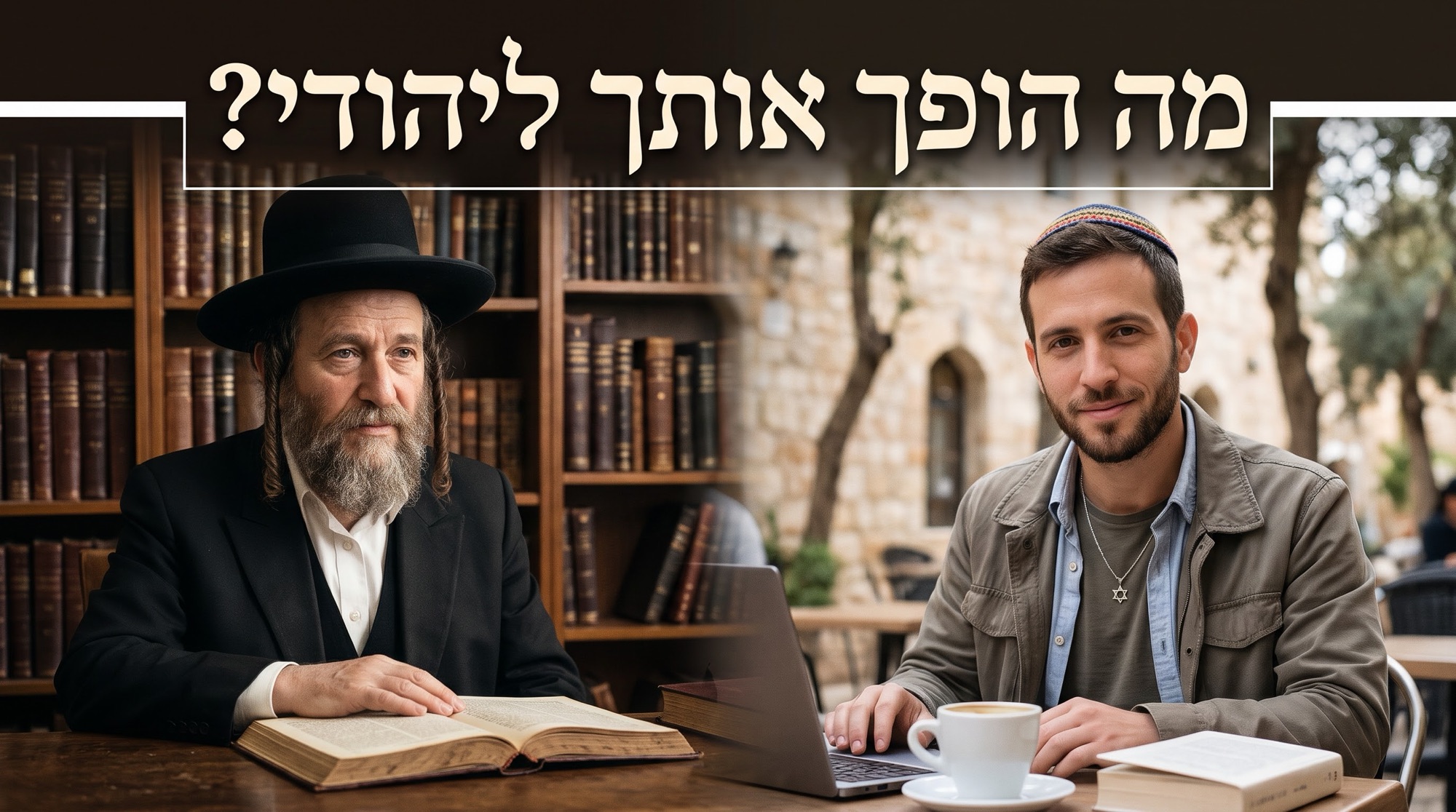
Prof. Kate Litvak, a law lecturer in the United States, recently published a sharp article about Western Jews. She defines herself as an atheist, and asks a simple and pointed question: if you do not believe in God, what makes you a Jew?
The answer she describes is troubling. The religious definition has been abandoned. The genetic definition is not accepted in respectable circles. All that remains is an ideological definition — "Jewish values". But these values have shrunk to "doing good for the world", and from there, in her words, to support for one political agenda. And she points to the failure: such a definition does not distinguish between a Jew and any other person who holds the same opinions.
One can argue with her political positions. But the question she raises cannot be bypassed. And I want to say: the problem is not that the wrong ideology was chosen. The problem is that we look for the Jew in ideology at all. Every definition of a Jew by his opinions — left or right — turns him into a member of a club of worldviews, and leaves the question open.
Faith in one God alone is not a sufficient answer either — other religions claim it too. Nor are the kippah (skullcap), the tzitzit (ritual fringes worn on a four-cornered garment), the tefillin (small leather boxes containing Torah verses, worn during weekday morning prayer) and circumcision. These are signs of a Jew, not his definition. A sign points to a thing; it is not the thing itself.
The answer I seek to offer is found at the beginning of the road: in the Patriarchs and Matriarchs. Abraham, Isaac and Jacob, Sarah, Rebecca, Rachel and Leah were not born into a Jewish people. They created it. And what created it was not a set of values or positions — but a series of trials (nisyonot), and above all: standing firm in them.
Every trial they withstood imprinted one quality into the soul of the people. The trial alone creates nothing — the wicked were tested too. Standing firm in the trial is what turns a person into a template, into a "banner" (nes) that we lift our eyes to.
And there is no Torah portion more fitting for this than "Chayei Sarah" (one of the weekly Torah portions read in synagogue on Shabbat, Genesis 23–25) — the portion that opens right after the Binding of Isaac, with the passing of Sarah, and with Abraham's last and quietest trial.
Nisayon: "Nes" and "Yavan" in One Word
The Torah writes: "And God tested (nisah) Abraham". The Midrash (classical rabbinic interpretation of the Bible; here Bereshit Rabbah 55:1, the Midrash on Genesis) does not read this only as an "exam". It quotes "You have given those who fear You a banner (nes) to be raised high" and expounds: trial after trial — in order to raise them up like the mast (nes) of a ship. A nes is a flag hoisted high. The trial raises a person until he can be seen from afar.
Here I want to deepen the reading of my own. In the Hebrew word "nisayon" (trial) two words dwell: nes and yon.
Nes — to rise above human nature. To go up above matter, above physicality, and even above logic. This is complete faith, a certainty that needs no proof. Chassidut (Hasidic teaching, the Jewish spiritual movement founded in the 18th century) calls this "above reason and understanding".
Yon — the absolute descent into matter, into logic, into philosophy. Yon is the wisdom of Greece (Yavan), of which the Sages (the rabbis of the Talmud and Midrash) said that it darkened the eyes of Israel. But "yon" also has a biblical meaning: "I sink in deep mire (yeven metzulah)" (Psalms 69:3), "the miry clay (tit ha-yaven)" (Psalms 40:3). Yaven is mud, clay in which one sinks.
The trial, then, does not happen in heaven. It happens in the mud. Every trial begins in the "yon" — in a logical claim, in a real fear, in the calculation of this world. The Midrash (Tanchuma Vayera 22) tells that the Satan walked with Abraham on the way to Mount Moriah and argued against him with completely logical arguments: "An old man like you will destroy his son?"
Standing firm in the trial is the moment in which a person, inside the yon, raises the nes. He does not flee the world — he raises it. This is exactly the difference between a nazirite (in the Bible, one who takes a vow to abstain from wine and worldly pleasures) who flees from matter and a Jew who grapples with it. And Noah blessed: "May God enlarge Yefet, and may he dwell in the tents of Shem" (Yefet and Shem are Japheth and Shem, two of Noah's sons; tradition sees Shem as the ancestor of Israel) — and Yavan is one of the sons of Yefet. The beauty of Yefet can dwell in the tents of Shem, on condition that the tent belongs to Shem.
Greece: The Level of Matter
To understand where the trial can bring us down, we need to understand what Greece is. Greece is not only an ancient empire. It is a level in the soul, a whole worldview, and four foundations can be identified in it.
Beauty as holiness. The Greeks saw outer beauty as a supreme value. Their ideal, "kalokagathia", held that the beautiful and the good are one thing. What is pleasant to the eye — is the truth. Judaism says the opposite: "Charm is false and beauty is vain; a woman who fears the Lord, she shall be praised".
The culture of the body. The Greek gymnasium was a temple. Competitions were held in it naked, and the perfect body was the object of admiration. The First Book of Maccabees tells that the Hellenizers in Jerusalem built a gymnasium next to the Temple, and were ashamed of circumcision until they tried to hide it. The body turned from a vessel into a goal.
Human logic as the summit. Protagoras said that man is the measure of all things. Aristotle saw in theoretical reason the highest perfection. What cannot be proven — does not exist. The Maharal (Rabbi Judah Loew of Prague, the 16th-century sage and thinker), in his book Ner Mitzvah, explains that the kingdom of Greece is the kingdom of human reason, which does not recognize what is above reason.
The culture of the ego. The Greek hero seeks glory for himself. Achilles chooses a short life and an eternal name. Man stands at the center, and the gods themselves are enlarged human beings, with their jealousy and their desires. Facing this stands Abraham and says: "I am but dust and ashes".
What Exactly the Greeks Wanted From Us
In the "Al HaNissim" prayer (the thanksgiving prayer added during Hanukkah, which recalls the Maccabees' victory over the Greeks) it says that the Greeks rose up against Israel "to make them forget Your Torah and to make them transgress the statutes of Your will". They did not seek to burn the Torah. They wanted it to be one more wisdom, one more beautiful book of philosophy. What bothered them were the "chukim" (statutes) — the commandments that are above logic.
That is why they decreed specifically against Shabbat (the Sabbath), Rosh Chodesh (the celebration of the new moon that begins each Hebrew month) and circumcision. Shabbat — holiness in time, above human labor. Rosh Chodesh — the ability to renew oneself, that not everything is cyclical and fixed. Circumcision — the seal of the covenant in the body itself, that the body is not yours alone. All three are a "nes" within nature.
And they did not break the cruse of oil — they defiled it. This is the Greek trial in its purity. It does not destroy holiness; it leaves it in place and empties it from within. And the miracle of Chanukah is one cruse, sealed with the seal of the High Priest, which the Greek hand did not touch. This is the inner point that is in every Jew.
The Beauty of Yefet in the Tents of Shem
It is important to say: Judaism does not hate beauty, body or reason. The Sages (Megillah 9b) permitted writing a Torah scroll in Greek, because "the beauty of Yefet shall be in the tents of Shem". The question is not whether there is beauty, but who serves whom. When beauty, body and logic are vessels for holiness — that is elevation. When they become the goal and the measure of everything — that is the level of Greece.
Abraham: Mesirut Nefesh — the Readiness to Go Beyond Yourself
"With ten trials Abraham our father was tested, and he withstood them all, to make known how great was the love of Abraham our father" (Avot 5:3 – Pirkei Avot, "Ethics of the Fathers," a classic collection of rabbinic wisdom). The Rambam (Maimonides, the 12th-century philosopher and legal authority) and Rabbeinu Yonah (a 13th-century Spanish sage) count them differently, but the common thread is clear: every trial asked Abraham to give up one more layer of "self".
- Lech Lecha (Go forth) — leaving land, birthplace and father's house. Giving up the identity he had received.
- The famine and the descent to Egypt — the promise "I will make you a great nation", and immediately famine. And he did not question.
- The taking of Sarah to Pharaoh and to Abimelech — a person's most real fear.
- The banishing of Hagar and Ishmael — "and the matter was very grievous in Abraham's eyes". Against his own compassion.
- The Binding of Isaac — offering the son upon whom the entire promise was built.
- The burial of Sarah — Rabbeinu Yonah counts it as the tenth trial.
Chassidut goes deeper into the Binding: Abraham is the man of chesed (loving-kindness). The trial was not only to give up a son — but to act against his own trait, in the trait of gevurah (strength). Whoever is able to step out even of his good traits, when the supreme will demands it, has discovered that there is in him a point deeper than any trait. This is "mesirut nefesh" — the point of Jewishness that does not depend on any revealed power.
And the trial of our portion is quieter. God promised Abraham "to you I will give it", and when the day comes he must pay Ephron four hundred shekels of silver for a burial cave. The Sages (Sanhedrin 111a) bring that he did not question the ways of the Holy One, blessed be He. There is no altar here and no knife — only a mourning man standing before a cunning merchant and guarding his dignity and his faith.
The value that was created: mesirut nefesh, and the ability to go beyond the limits of yourself — a "Lech Lecha" that accompanies every Jew in every generation.
Sarah: "All of Them Equal in Goodness" — Wholeness in Every State
The portion opens: "And the life of Sarah was one hundred years and twenty years and seven years, the years of the life of Sarah". Rashi (the classic 11th-century commentator on the Torah and Talmud) asks why the word "years" is repeated, and answers: all of them were equal in goodness. At one hundred she was like twenty in freedom from sin, and at twenty like seven in beauty.
This is not a description of an easy life. Sarah was barren for decades. She was taken to the house of Pharaoh and to the house of Abimelech. She was forced to see her maidservant enter her tent and belittle her. And in the end, according to Rashi, her soul departed when she heard about the Binding.
And with all this — "all of them equal in goodness". Sarah's trial was a trial of time. Not one dramatic moment, but decades in which circumstances changed and she did not. The Kabbalists identify Sarah with the aspect of "Binah" (Understanding – one of the ten sefirot, the divine attributes in Kabbalah), the supernal mother, from whom stability flows.
Sarah also had a vision that Abraham did not see. "Whatever Sarah tells you, listen to her voice" — the Sages say she was greater than him in prophecy. When she demanded that Ishmael be sent away, she saw the future of the house and not only the feelings of the present.
The value that was created: an inner consistency that does not change with circumstances, and a vision of the future of the Jewish home. She is the woman who is "in the tent" — the home as a sanctuary, whose Shabbat candle burns from one Shabbat eve to the next.
Isaac: An Unblemished Offering — To Stay and to Continue
In the Binding we usually speak about Abraham. But Isaac was thirty-seven according to the Sages, and he went willingly. "And the two of them went together" — twice. The father who gives up the son, and the son who gives up himself.
From then on Isaac was called an "unblemished offering", and so he was forbidden to leave the Land of Israel. When the famine came, God said to him: "Do not go down to Egypt; dwell in the land". Abraham's trial was to go; Isaac's trial was to stay.
And Isaac digs wells. "And Isaac dug again the wells of water which they had dug in the days of Abraham his father… and he called them by the same names his father had called them." The Philistines stop them up, and he digs again. And again. Chassidut sees in this the service of Isaac: to dig into the dust of the world until living waters spring forth.
The value that was created: gevurah and awe, cleaving to the place and to the tradition, and the ability to continue the way of the fathers without seeking something new. A Jew digs the wells of his fathers and is not ashamed to call them by the same names.
Rebecca: A Rose Among Thorns — Chesed and Decisiveness
Rebecca grew up in the house of Bethuel and Laban. The Sages call her "a rose among the thorns". Her trial is a trial of environment: to keep purity when the whole house around you is deceit.
At the well she gives water to a stranger and ten camels, without being asked. This is the chesed of Abraham, revealed precisely in someone who did not grow up in his tent. And when her brother and mother try to delay, she answers in one word: "I will go". That is her "Lech Lecha".
In pregnancy she says "If so, why am I like this?", and goes to inquire of God. And in the blessings she takes full responsibility: "Upon me be your curse, my son". She saw who was worthy to carry the blessing, and acted — even though it cost her longing for her son all her days.
The value that was created: chesed that is not conditional, and the power of decision — knowing what is right and carrying the responsibility for the decision.
Jacob: "For You Have Striven" — A People Named for a Struggle
Jacob's life is a continuous series of trials without pause. Fleeing from Esau. Twenty years with Laban: "by day the heat consumed me and the frost by night". Ten changes in his wages. Dinah. And Joseph — "Jacob sought to dwell in tranquility; the anguish of Joseph leapt upon him" (Rashi, Bereshit 37:2).
Jacob's trial is the trial of exile: to live long years in the house of a deceiver and come out of there whole. "With Laban I sojourned — and I kept the 613 commandments and did not learn from his evil deeds" (Rashi 32:5). This is the "yon" in its purity — the world that convinces you that it is the only truth.
And on that night at the crossing of the Jabbok, Jacob wrestled until dawn. He did not win easily, and he came out limping. But he did not let go: "I will not let you go unless you bless me". And there he received the name that would be the name of the whole people: "Your name shall no longer be called Jacob, but Israel, for you have striven with God and with men and have prevailed".
Think about it: the people is named for a trial. Not for an easy victory, not for a simple faith — for a struggle in which they stood and did not break.
The value that was created: truth ("You give truth to Jacob"), standing firm in exile without assimilating, and a holy stubbornness that does not let go until the darkness itself blesses.
Rachel: A Silence That Saves
Jacob and Rachel knew that Laban would deceive, and they passed signs between them. On the wedding night Rachel saw her sister about to be put to shame — and gave her the signs (Megillah 13b). She gave up the man she loved, and stayed silent, so that her sister would not be shamed.
That is why, the Midrash says (Eichah Rabbah, Petichta 24), when all the Patriarchs could not annul the decree of destruction, it was Rachel who raised this claim — and was answered: "Withhold your voice from weeping… and the children shall return to their own border".
The value that was created: compassion, and giving up yourself for the sake of another's dignity, and a motherhood that weeps for her children in every exile.
Leah: Thanksgiving — the Source of the Name "Jew"
Leah is the woman whose "eyes were weak" — from weeping, says Rashi, because she thought she would be married to Esau. Her trial is the trial of a woman who is not loved: "And the Lord saw that Leah was hated". She names her first sons out of pain: "For the Lord has seen my affliction", "For the Lord has heard that I am hated".
And with the fourth son something changes. "This time I will thank (odeh) the Lord — therefore she called his name Judah (Yehudah)". The Sages say (Berachot 7b): from the day the Holy One, blessed be He, created His world, there was no person who thanked Him — until Leah came.
This may be the most direct answer to the article's question. The name "Jew" (Yehudi) comes from Judah, and Judah comes from Leah's thanksgiving. A thanksgiving born within pain, not in its place. A Jew is one who gives thanks — even when he does not understand, even when he did not receive what he hoped for.
The value that was created: gratitude, prayer that changes a decree, and the ability to give thanks from within the difficulty and not only after it.
Life as a Ladder: Trial After Trial
The Patriarchs did not go through one trial. Abraham went through ten, and Jacob did not know tranquility all his days. This is not a coincidence. The life of a Jew is one great process, in which he goes through a trial, and another trial, and another one. Every trial is a junction: from here one rises to the next spiritual level, and from here, God forbid, one descends to the level of Greece.
Jacob's Ladder
Jacob dreams of "a ladder set up on the earth, and its top reached to heaven, and behold the angels of God ascending and descending on it". The ladder stands on the ground — in matter, in the yon. Its top is in heaven — in the nes. And on the ladder there is no standing still: one either ascends or descends. In gematria (the traditional system in which each Hebrew letter has a numerical value) "sulam" (ladder) equals 130, like "Sinai". The Torah is the ladder itself.
The prophet says (Zechariah 3:7): "And I will give you places to walk among these that stand". The angels are "standers"; man is a "walker". The angel stands at his level; man is always in motion. And every trial is a rung on the ladder.
Whoever Is Greater Than His Fellow
The Sages say (Sukkah 52a): "Whoever is greater than his fellow, his inclination is greater than his". The higher a person rises, the greater his trials. Whoever has risen a level has not received rest — he has received a new trial, deeper and subtler. The trial of Abraham at the Binding would not have been possible for the young Abraham in Ur of the Chaldees.
And so the Midrash (Bereshit Rabbah 55:2) continues immediately: "The Lord tests the righteous". The potter does not test cracked vessels, because with one knock they break. He tests the strong vessels. The trial is not a punishment — it is a testimony to strength.
The Descent Before the Ascent
Rabbi Nachman of Breslov (the 18th–19th-century Hasidic master, great-grandson of the Baal Shem Tov) teaches that it is impossible to rise from level to level without a preceding descent. Every new level begins with a feeling of falling, of confusion, of "yon". Whoever understands this is not alarmed by the descent. He knows it is a gate.
The Baal Shem Tov (Rabbi Israel ben Eliezer, the 18th-century founder of the Hasidic movement) told a parable: a father teaches his son to walk. He stands close, and the child walks toward him. Then the father steps back, and another step. The child thinks his father is moving away from him — but the father moves away so that the child will learn to walk by himself. The hiding of the face in a trial is not abandonment. It is education.
And the Fall?
"For a righteous man falls seven times and rises" (Proverbs 24:16). The verse does not say that the righteous man does not fall. It says that the righteous man rises — and some explain: it is precisely through the falling that he becomes righteous. Even a descent to the level of Greece is not the end of the road. The next trial is already waiting, and it is a new opportunity to rise.
The Powers of the Soul That the Trial Demands
The trial does not demand of a person a little more effort. It demands powers that the person did not know he had. And precisely here lies its secret: the trial does not only test the powers — it reveals them.
Two Souls
The author of the Tanya (Rabbi Shneur Zalman of Liadi, founder of Chabad Hasidism; the Tanya is his foundational book on the inner life of the soul) describes man as an arena of two souls. The animal soul wants what is pleasant, beautiful and understood — it is the "yon" within us. The divine soul, "a part of God above, truly", is drawn to what is beyond. Every trial is a moment in which the two fight over the same deed. And the person — he is the one who decides.
The Rambam (Laws of Teshuvah 5) states that choice is given to every person: every person can be as righteous as Moses our teacher or as wicked as Jeroboam. There is no predetermined decree. The trial is the place in which this choice becomes real.
The Powers the Patriarchs Bequeathed
Each of the Patriarchs and Matriarchs revealed one power, and that power was imprinted in the soul of the people. When a Jew stands in a trial, he draws from this inheritance:
- Mesirut nefesh (Abraham) — the readiness to give up everything, even understanding itself. The author of the Tanya calls this the "hidden love" that is in every Jew.
- Gevurah (Isaac) — "Who is mighty? He who conquers his inclination" (Avot 4:1). Not the bodily might of Greece, but inner might.
- Truth (Jacob) — not changing according to the environment, even twenty years in the house of Laban.
- Faith and trust (Sarah) — holding on to the promise for decades, when all of reality contradicts it.
- Decision and responsibility (Rebecca) — knowing what is right and carrying the consequences.
- Self-nullification and giving up (Rachel) — setting yourself aside for the sake of the other.
- Thanksgiving (Leah) — saying thank you from within the pain, not after it.
There Is No Trial Beyond One's Strength
The Sages say (Avodah Zarah 3a) that "the Holy One, blessed be He, does not come with complaints against His creatures" — He does not demand of a person what he cannot do. From here flows a deep principle: if a trial has come to you, it is a sign that you have the strength to withstand it. It may still be hidden, but it is there.
The trial, then, is a letter of trust. The Holy One, blessed be He, says to a person: I know what is in you, even if you do not know it yet. And standing firm in the trial is the moment in which the person discovers himself — not what he thought he was, but what he truly is.
Our Trial Today: Greece Did Not Fall
The Greek empire fell two thousand years ago. But the level of Greece is more alive than ever. In many senses, the Western culture in which we live is its direct heir. And so the trials of our generation are not only "Lech Lecha" or "take now your son". They are Greek in nature.
The body as a temple. The screen shows us hundreds of times a day a perfect body, a perfect face, a perfect life. Outer beauty is rated, ranked and receives "likes". The trial is not to forget that the body is a vessel — to guard it, to honor it, but not to worship it.
The ego at the center. The culture of the "I": self-branding, success as the measure of worth, the need to be seen. Abraham said "Hineni" — here I am, for You. Greece says "Here I am" — look at me.
Logic as a limit. Whatever cannot be measured, tested in a laboratory or explained — is pushed to the margins. Faith is considered weakness. The trial is to use reason to its fullest, and also to know where it ends.
Defilement, not breaking. As with the cruse of oil, the main danger is not that we abandon Judaism. The danger is that we keep its form and empty it of content: Shabbat as "quality time", prayer as "meditation", a mitzvah as "a beautiful tradition". Everything remains — only the nes has disappeared.
There is no call here to flee from the world. Abraham did not flee into closed seclusion; he sat "at the opening of the tent in the heat of the day" and met passing guests. The question is one: in every encounter with Greece — who raises whom. Am I bringing the beauty of Yefet into the tents of Shem, or is Yefet bringing me into his gymnasium.
A Response to Litvak: "Tikkun Olam" Without "the Kingdom of the Almighty"
What Prof. Litvak describes is, in my view, the Greek trial in its purity. Judaism did not break in the institutions she describes. The schools, the camps, the community centers — they all stand. But like the cruse of oil, they remained whole from the outside and were defiled from within. The Torah became "values": a human, understandable wisdom that any enlightened human mind can agree with. This is exactly "to make them forget Your Torah and to make them transgress the statutes of Your will".
And there is a precise symbol for this. The expression "tikkun olam" (literally "repairing the world"), which became the central slogan of liberal Judaism, is taken from the "Aleinu LeShabe'ach" prayer (the prayer that closes every Jewish prayer service). But there it appears in full: "to repair the world in the kingdom of the Almighty (letaken olam be-malchut Shaddai)". The modern slogan cut off its second half. The human repair remained, and the kingdom above it disappeared. The yon remained, and the nes disappeared.
And Litvak's claim — that such a definition does not distinguish a Jew from any other person — is exactly what the Greeks wanted. They did not demand that the Jews stop being good. They demanded that they be good like everyone: according to human reason, according to the spirit of the time, without Shabbat, without Rosh Chodesh and without the covenant. Without what distinguishes.
Chesed Without the Binding
But there is also a point of compassion here, and it must not be given up. The drive of many Jews in the West to help the weak and the oppressed is not random. Litvak herself calls it "a maternal instinct that has been turned in the wrong direction". In my eyes this is the chesed of Abraham, which still burns in their souls. The author of the Tanya calls this "hidden love" — a spark that exists in every Jew, even in one who says he does not believe.
The Kabbalists teach that chesed without gevurah is not a holy trait. Chesed that has no boundary spills into every place, even into places that are not worthy of it. That is why Abraham, the man of chesed, had to go through the Binding. Only after his chesed passed through gevurah, through the "Hineni" to a will above him, did it become the template of a people.
This, then, is the answer to Litvak's question. If you do not believe in God, what makes you a Jew? Not your opinions, on any side. What makes you a Jew is the soul you carry — a soul that went with Abraham to Mount Moriah, with Jacob at the Jabbok, and with Leah who said "this time I will give thanks". One can ignore it, but not erase it. The sealed cruse of oil is in every Jew. And the next trial in his life is the opportunity to light it.
In Summary: Why Precisely the Trial
Why does the Holy One, blessed be He (a traditional Jewish name for God), test? After all, He knows what is in a person's heart. The Ramban (Nachmanides, the 13th-century Spanish sage and Torah commentator), on Bereshit (Genesis) 22:1, answers: the trial is for the benefit of the one being tested. What was in potential, in the heart, needs to come out into actuality, into deed. Faith that has not been tested is a possibility. Faith that has withstood a trial is a reality.
Chassidut adds a layer: the trial reveals what is beyond the revealed powers — the "essence of the soul". A person withstands a trial not by the power of his logic (that is the yon) and not by the power of his traits. He stands by the power of an inner point that cannot be explained. That is the nes.
And so the template was created. From Abraham we inherited mesirut nefesh — the ability to go beyond ourselves, from "Lech Lecha" to the Binding. From Sarah — an inner consistency that does not change with circumstances, and a vision of the future of the home. From Isaac — gevurah and faithfulness to the wells of the fathers. From Rebecca — chesed that is not conditional, and the strength to decide and to carry responsibility. From Jacob — truth, and the ability to stand in exile without assimilating. From Rachel — compassion, and giving up oneself for the sake of another's dignity. And from Leah — thanksgiving, from which our name comes: Jews.
But this is not a list of qualities received once. Each of these values is tested again in every generation, and in every person, again and again. In every trial the Jew stands on a rung of the ladder. On one side the nes — faith, self-nullification, mesirut nefesh. On the other side the yon — body, ego, a logic that does not recognize anything above it. And he chooses.
A Jew, then, is not defined only by what he believes or what he wears. He is defined by what he does when the world presses. He carries within him the memory of Abraham on the mountain, of Jacob at the Jabbok, of weeping Leah who gives thanks. Every trial in his life is an opportunity to be, for a moment, one of them.
On Shabbat "Chayei Sarah" we will remember: the portion is called "The Life of Sarah" even though it begins with her death. For whoever has withstood his trials — lives. And "all of them were equal in goodness".

The soul is thirsty. The path begins within.
A journey of healing that unites clinical psychology with the wisdom of Kabbalah and Chassidut – for anyone who feels that pain is a letter from the soul, asking us to return to our source.
Sources for Further Study
- On the word "nisayon": Bereshit Rabbah 55:1 ("a banner to be raised"); Ramban, Bereshit 22:1; Guide for the Perplexed III:24; Psalms 69:3 and 40:3 ("yaven" as mud).
- Abraham: Avot 5:3 with the commentaries of the Rambam and Rabbeinu Yonah; Tanchuma Vayera 22 (the Satan on the way to Moriah); Sanhedrin 111a; Maharal, Derech Chaim on Avot 5:3.
- Sarah: Rashi, Bereshit 23:1–2; Shemot Rabbah 1:1 and Rashi, Bereshit 21:12 (Sarah greater in prophecy).
- Isaac and Rebecca: Bereshit Rabbah 64:3 (unblemished offering); Bereshit 26:18; Vayikra Rabbah 23:1 (a rose among thorns).
- Jacob: Rashi, Bereshit 32:5 and 37:2; Bereshit 32:25–29.
- Rachel and Leah: Megillah 13b; Eichah Rabbah, Petichta 24; Jeremiah 31:14–16; Berachot 7b; Rashi, Bereshit 29:17.
- Chassidut and Kabbalah for deepening: Sefat Emet on Vayera and Chayei Sarah; Tanya, chapter 18 ("hidden love" and mesirut nefesh); Likkutei Sichot on Vayera (the trial as elevation); Zohar, Parashat Chayei Sarah.
- Greece: the "Al HaNissim" prayer; Bereshit Rabbah 2:4 ("and darkness — this is the exile of Greece"); Megillah 9b; I Maccabees 1; Maharal, Ner Mitzvah.
- Life as a ladder: Bereshit 28:12 and Baal HaTurim there (ladder = Sinai); Zechariah 3:7; Sukkah 52a; Bereshit Rabbah 55:2 ("the Lord tests the righteous"); Proverbs 24:16; Likkutei Moharan (descent for the sake of ascent); Keter Shem Tov (the parable of the father and son).
- Powers of the soul: Tanya, chapters 1–2, 9, 18; Rambam, Laws of Teshuvah 5:2; Avot 4:1; Avodah Zarah 3a.
- The response to Litvak: Prof. Kate Litvak's article (in Hebrew translation); the "Aleinu LeShabe'ach" prayer ("to repair the world in the kingdom of the Almighty"); Tanya, chapters 18–19 (hidden love); Zohar and Etz Chaim on Chesed and Gevurah.