
By: Ofir Yosef Cohen Touval | Maim Hayim
In the Introduction to the Book of the Zohar (the foundational work of Kabbalah) there is a story I return to again and again.
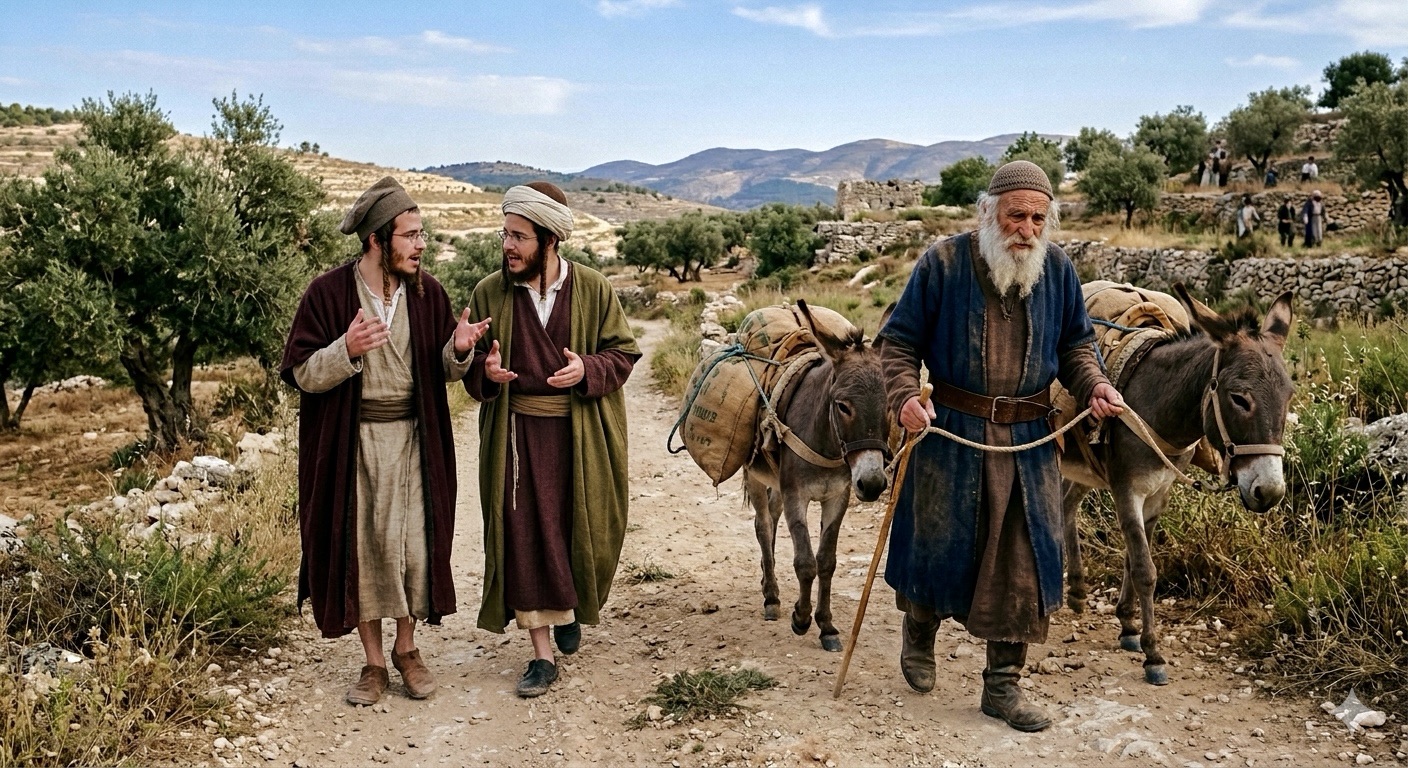
Rabbi Elazar, son of Rabbi Shimon bar Yochai (the great sage to whom the Zohar is attributed), and Rabbi Abba set out on a journey to visit Rabbi Elazar's father-in-law. Behind them walks a simple man driving the donkeys. In the Zohar's Aramaic he is called "Ta'in Chamarei," the donkey driver. Rabbi Abba says: "Let us open the gates of Torah, for now is the hour to be corrected on our way."
They study, and the donkey driver is silent. Then he opens his mouth, and out come secrets about the Sabbath, about the hidden point at the heart of creation, about letters and supernal unions, until the two sages climb down from their donkeys and kiss him. At the end of the story it is revealed who he is: the son of Rav Hamnuna Saba (a legendary sage of the Zohar), and on a deeper level, Rav Hamnuna Saba himself.
You can read this story as a lovely parable about humility. But Baal HaSulam, Rabbi Yehuda Ashlag (the 20th-century Kabbalist who wrote the Sulam, or "Ladder," commentary on the Zohar), reads in it a complete map of the spiritual path. The donkey driver is not just another character in a story. He is a force at work in the life of every one of us.
The Journey That Is Not a Journey
According to Baal HaSulam, this is not a walk on foot. It is "the path of the righteous, like the light of dawn, growing brighter until full day": an ascent from one spiritual level to the next. Going to see the father-in-law means rising to attain the inner light of a particular level, which in Kabbalah is called Neshamah. And their destination is higher still: Chayah, and after it Yechidah.
Kabbalah speaks of five levels of the soul: Nefesh, Ruach, Neshamah, Chayah and Yechidah. Neshamah is deep inner understanding. Chayah is the living vitality of the highest wisdom. Yechidah is the root of the soul, the point that is one with the Creator.
So who is the donkey driver? Here comes the great insight. Baal HaSulam explains that the donkey driver is the "ibur" of a righteous soul: a higher soul that God sends to a person to help him leave his level and rise. (Ibur literally means "gestation"; it describes a higher soul that joins a person for a time, hidden inside him.)
Without this help, he writes, the righteous could not move from where they stand. So God sends each person a lofty soul suited to his stature and his level. But there is a surprising condition: at first, the person does not recognize it at all. It looks to him like the lowest soul imaginable. A donkey driver. And the Sages (the rabbis of the Talmud) even said that most donkey drivers are wicked.
The highest help almost always arrives in the lowliest clothing.
Only after this soul completes its task and brings the person to the level he needs is it revealed. Baal HaSulam calls this "the revelation of the souls of the righteous." And then we understand who walked with us the whole way.
The Donkey Is Matter
It is no accident that the Zohar chose a donkey driver. In Hebrew, chamor (donkey) shares its letters with chomer (matter): the body, habits, hardships, the daily struggles of life. The donkey driver walks behind and moves all this heaviness forward. Sometimes the one who leads us through matter, through simple, unimpressive everyday reality, is the very messenger who leads us to the light.
How often do we look for the answer somewhere grand and impressive, certain that truth must arrive wrapped in titles and status? And then a child, a patient, a taxi driver, a neighbor, or an event that seems completely random says one sentence that lights up the whole road.
The Sabbath That Is Not Holy in Itself
What does the donkey driver teach? His first subject is the verse "You shall keep My Sabbaths and revere My sanctuary." The Zohar explains that the first three days of creation were hidden, and only on the fourth day was their work revealed. In Kabbalah the fourth day is Malchut, "Kingship," the sefirah (divine attribute) that has nothing of its own and only receives. It is precisely what lacks and receives that reveals the wholeness of everything above it.
Then the donkey driver asks: if the Sabbath is the aspect of Malchut, why does the verse call it "My sanctuary," a holy thing? And he answers: the Sabbath itself is not holy. Holiness descends upon it from above and rests on it. "Call the Sabbath a delight, the holy of the Lord honored": the Sabbath is honored, but the honor is not its own.
This is a deep psychological principle. A person is not the source of the light. He is the vessel the light rests upon when he is open to receive.
The Sabbath Left in Shame
Then comes one of the most moving passages in the entire Zohar. One Sabbath remained that was not mentioned, and it stood in shame. It said before God: Master of the world, from the day You made me I have been called Sabbath, and there is no day without night.
Who is she? Baal HaSulam explains that this is the innermost point of Malchut, "the middle point." It is the point on which the first contraction of creation took place (the tzimtzum, God's original withdrawal of light to make room for the world), and it receives no light even on the Sabbath. At the beginning of creation, in the highest world called Adam Kadmon, all the light passed through her. Now she is closed, locked, and waiting.
What does God answer her? "You are a Sabbath for the future": at the final correction of the world you will be a complete Sabbath. "But here, I crown you with a higher crown": even now I crown you with a loftier crown. Baal HaSulam explains that she rises and is set right in the highest place of all, in the secret of "the air that is not known."
The most wounded point in us, the one left behind and ashamed, is the one that will be crowned with the highest crown of all.
In the clinic I meet this point again and again. The part a person hides, the part he is sure can never be fixed, the part about which he says, "That's just me, it will never change." The Zohar says: this is not the point that was abandoned. This is the point that is waiting for its crown.
Circle and Square, Remember and Keep
The donkey driver goes on to explain the word "My Sabbaths," in the plural: there is an upper Sabbath and a lower Sabbath, "a circle and a square." Baal HaSulam interprets: the circle is the aspect of the head, where light is equal everywhere and there is no judgment at all. The square is the aspect of the body, where there is right and left, front and back, boundaries.
On the Sabbath the square rises and is included within the circle. On the Sabbath the body, with all its boundaries, is gathered into a light that holds no judgment. That is why the lower Sabbath is called "Keep" (shamor), guarding against judgment, and the upper Sabbath is called "Remember" (zachor), because there is nothing there to guard against. It is "the King to whom peace belongs," and there is no conflict in it at all. (The Torah gives the Sabbath commandment twice, once as "Remember" and once as "Keep.")
From here come the two kinds of peace within us, "Peace, peace, to the far and to the near." Jacob is "the far": the highest wisdom, which cannot be received without a garment of loving-kindness, "From afar the Lord appeared to me." Joseph is "the near": the loving-kindness that clothes that wisdom and makes it possible to receive. A high light needs a garment of kindness so that we can hold it.
"Those Who Profane It Shall Die"
Then comes a warning: "Revere My sanctuary." This is the point standing in the middle, which must be revered more than anything, for of it is said, "those who profane it shall surely die." Who profanes it? Whoever enters the hollow space of the circle and the square, the place of that point, and damages it.
Baal HaSulam explains: this is someone who tries to draw light into the middle point before its time, and the light departs from him. There are places in the soul that must not be broken into by force. A closed point is not opened by breaking in, but with reverence.
And yet, upon this very point rests the hidden Name. The Zohar says the point is called "I" (Ani), and upon it rests the concealed One above, the Name of God. "I" and the Name are all one.
The Kiss, and the Secret Not Yet Revealed
Here Rabbi Elazar and Rabbi Abba climb down from their donkeys and kiss the donkey driver. All this wisdom is in your hands, and you drive donkeys behind us? Baal HaSulam explains that the kiss is the attainment of the next level, Chayah. Now they recognize the worth of the soul that walked with them.
But the donkey driver says: "Do not ask who I am." Let us keep studying, and let each of us speak words of wisdom to light the way. Why? Because his task is not finished. He came to bring them all the way to Yechidah, and the level of Chayah is so complete in itself that they feel they have already arrived. The great danger on the spiritual path is not the fall. It is the feeling that we have already arrived.
Why One Must Become a Donkey Driver
They ask him: who made you walk here as a donkey driver? He answers with a riddle. The letter Yud waged war with two letters, Kaf and Samech, so that they would come and join with him. The Kaf would not leave its place, because it cannot exist even for one moment outside it. The Samech would not leave, because it must support those who fall, and without support they cannot stand.
Baal HaSulam takes the riddle apart. The Yud is the level of wisdom, the new level. Kaf and Samech spell kes, from the root of "covering": the previous light, which was covered and clothed. The Kaf is the link between the levels; if it moves, the Throne trembles and all the worlds with it. The Samech is the kindness that holds up the falling so they do not fall. His conclusion is sharp: the levels themselves are fixed. Only souls change as they travel.
Then the Yud came to him alone, kissed him, embraced him and wept: "My son, what shall I do for you? I am departing now, and afterward I will come to you and help you, and I will give you an inheritance of two letters higher than those that left": Yud and Shin, which spell yesh, "substance," as it is written, "to cause those who love Me to inherit substance, and I will fill their treasuries." "And so, my son, go and be a donkey driver."
Here is perhaps the deepest insight of the whole passage. Baal HaSulam writes that this is how it works at every level: whenever a person needs to receive a new level, he must first come to the departure of the previous light, and begin again. First ibur (gestation), then yenikah (nursing), then mochin (mature consciousness), as if he had never had any level at all.
The feeling that everything has been taken, that I am back at the beginning, a donkey driver again, is not failure. It is the gestation that comes before every new birth.
I see this in the clinic all the time. A person goes through a deep process, reaches a good place, and suddenly everything falls apart. He is sure he has gone backward. But the Zohar says: this is exactly the moment when the Yud kisses and weeps and says, "I am leaving, and I will return to you with complete light."
The Tower in the Air and the Great Fish
Rabbi Elazar and Rabbi Abba weep and ask: you ride, and we will lead the donkey behind you. He answers: "It is the King's command, until that donkey driver comes." Baal HaSulam explains that this hints at the Messiah, "humble and riding on a donkey." What they still lack is Yechidah, receiving the face of the King Messiah.
His dwelling place, he says, is a tower soaring in the air, and in it live God and one poor man. This is the palace of the Messiah. And his father? A single fish in the great sea, old and precious, who swallows all the fish of the sea and brings them out alive and whole, and crosses the entire sea in a single moment.
Baal HaSulam reads this as the hidden union in Atik Yomin (the "Ancient of Days," the most concealed level of the Divine), a union that will be revealed only at the final correction of the world. Every union below it includes only part of Malchut, but this one includes even the middle point, that same Sabbath left in shame. It swallows all souls into itself, like a candle before a torch, and brings them out anew, alive forever. That is where the soul of Rav Hamnuna Saba comes from. That is why it is so high, and so hidden.
Benayahu ben Yehoyada
When they tell him, "You are the son of Rav Hamnuna Saba," he opens with the verse "And Benayahu son of Yehoyada, son of a living man, great in deeds, from Kavtze'el" (Benayahu was one of King David's mightiest warriors). Baal HaSulam explains that these are very lofty souls that merited to take part in the highest union and to receive the light of Yechidah from it, and they are revealed to the righteous in this world.
"Yehoyada" means: He knows, but is not known to others. "A living man" is Yesod, the "Foundation," the attribute that gives and flows downward. "Great in deeds," because in the union of the final correction all the levels revealed over six thousand years are gathered in it at once. And "Kavtze'el," literally "God gathers," is Malchut, which gathers everything into herself, even all the suffering and hardship the world has known, as part of the yearning that raises the light.
The Zohar also describes "the holy hidden palace" where all the levels are gathered. Baal HaSulam explains: when a level departs because of the failings of those below, it is not lost. It rises and is stored away there. And so every level that was ever revealed is gathered there, one after another, until the final correction, when they are all renewed and come forth at once.
No light we attained and then lost has gone to waste. It is stored above, and it will return.
Even Destruction Is a Correction
The last chapter is hard and comforting at once. "He struck the two Ariels of Moav": these are the two Temples in Jerusalem. Baal HaSulam explains that the revelation of the great union is what caused the light that shone in the two Temples to depart, and so they were destroyed. "And I was among the exiles": the level called "I" is in exile. "By the river Kevar": a river that "already was" (kevar means "already") and is now cut off from its source. "The river shall be wasted and dried up": wasted in the First Temple, dried up in the Second. And "Moav" is read as me-av, "from the Father," our Father in heaven, from whom both Temples drew their light.
But he adds: these destructions are themselves the corrections that return the world to its state before the breaking. Then both Temples will stand forever, and "the light of the moon shall be as the light of the sun." Even departure, even destruction, are part of the great movement of light toward wholeness.
Insights for Life
1. Don't judge by the clothing. The highest help usually comes in the lowliest form. Before you judge a person or an event, ask: what has it come to bring me?
2. Be an open vessel. The Sabbath is not holy in itself. The light rests on you; it does not come from you.
3. Honor the point left in shame. The wounded, hidden part of you is the part that will be crowned with the highest crown.
4. Don't break in by force. A closed point is opened with reverence, patience and the right timing.
5. Don't be frightened by a new beginning. Every new level begins with gestation. Becoming a donkey driver again is a sign of ascent, not of falling.
6. No light is ever lost. What departed has been stored away, and it will return all at once.
Messengers don't always arrive with a sign. Sometimes they arrive with a donkey.
A Short Glossary
• Zohar: the central book of Kabbalah, written in Aramaic and attributed to Rabbi Shimon bar Yochai and his students.
• Baal HaSulam: Rabbi Yehuda Leib HaLevi Ashlag (1884-1954), author of the Sulam ("Ladder") commentary on the Zohar.
• Nefesh, Ruach, Neshamah, Chayah, Yechidah: the five ascending levels of the soul.
• Ibur: "gestation"; a higher soul that joins a person for a time to help him grow, or the first, hidden stage of any new level.
• Sefirot: the ten divine attributes through which the Infinite light flows into the world.
• Malchut: "Kingship," the last of the sefirot, which receives the light; it is also the Sabbath and the community of Israel.
• Tzimtzum: the original "contraction," in which the Infinite light withdrew to make room for creation.
• Final correction (Gmar HaTikkun): the end of days, when every broken part of creation is fully mended.
Sources for Further Study
• The Zohar, Introduction to the Book of the Zohar, the passage of the Donkey Driver (paragraphs 74-95 in the Sulam edition)
• The Sulam commentary of Rabbi Yehuda Ashlag, ad loc.
• Leviticus 19:30; Isaiah 58:13; Exodus 31:14
• Isaiah 57:19; Jeremiah 31:2; Proverbs 8:21
• II Samuel 23:20; Zechariah 9:9
• Ezekiel 1:1; Isaiah 19:5; Isaiah 30:26
Enjoyed this ❤️ Share it so others can read it too:
📖 The book Nativ Maim Hayim
💬 Daily awareness on WhatsApp
🎥 Nativ Maim Hayim on YouTube
🔗 Maim Hayim blog
🎧 The podcast on Spotify
👍 Facebook