
By: Ofir Yossef Cohen Touval | Path of Living Waters
The story of "the Oven of Akhnai" appears in the Babylonian Talmud (Tractate Bava Metzia 59b). It is one of the foundational texts of Judaism on the limits of human authority, on the relationship between absolute truth and an unfolding reality, on the inner work of character in the midst of a dispute, and on the mature responsibility placed on every person living in this world.
Part One: The Story in the Talmud's Own Words
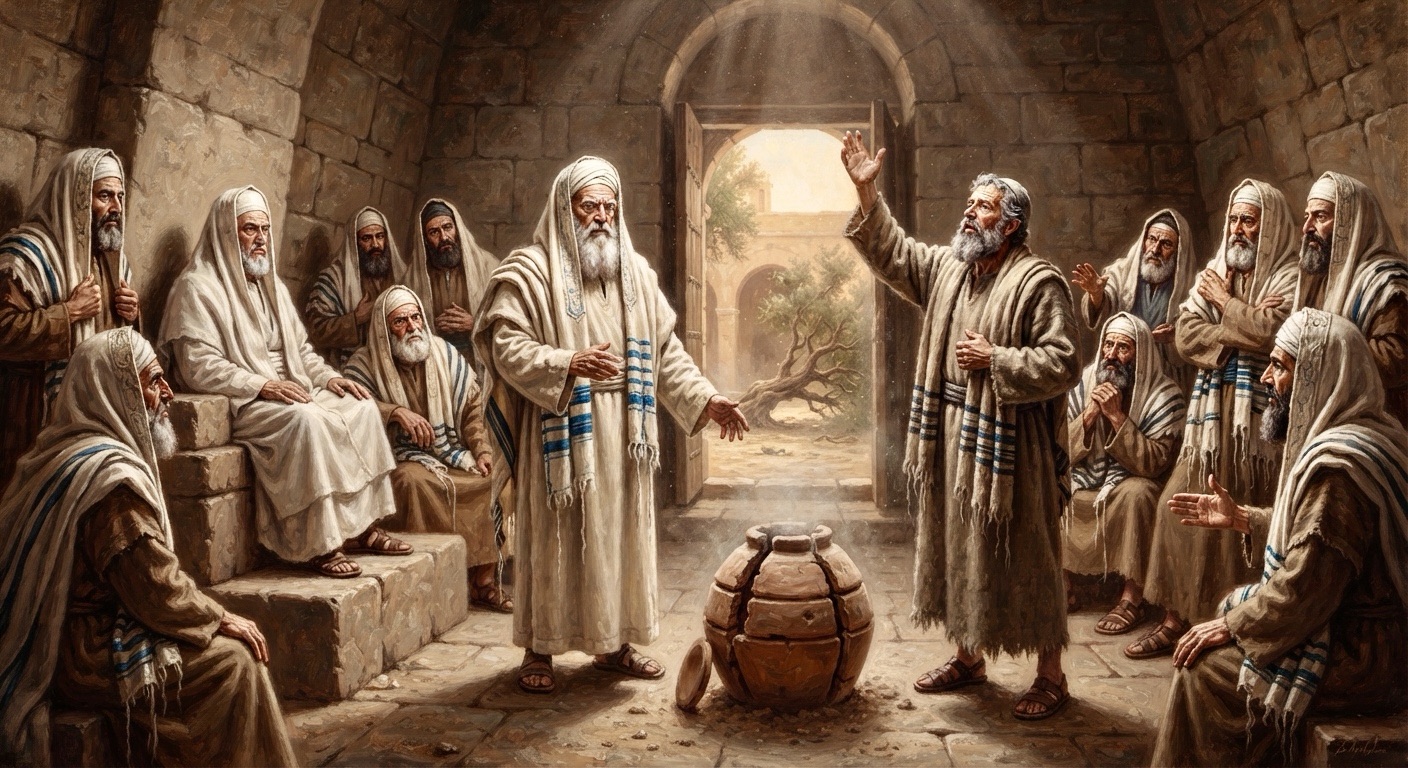
The dispute begins with a question of ritual purity (tumah and taharah, the laws that determine whether an object can become ritually impure). It concerns an unusual oven, built of separate clay rings with layers of sand between them: "the Oven of Akhnai," named after a snake (akhna) that coils around itself. Rabbi Eliezer ben Hyrcanus rules that it is pure; the Sages, headed by Rabban Gamliel, rule that it is impure.
The original text (Bava Metzia 59b, in translation):
"On that day Rabbi Eliezer brought every answer in the world, but they did not accept them from him.
He said to them: If the law is as I say, let this carob tree prove it! The carob tree was uprooted from its place a hundred cubits, and some say four hundred cubits. They said to him: One does not bring proof from a carob tree.
He said to them again: If the law is as I say, let the stream of water prove it! The water flowed backward. They said to him: One does not bring proof from a stream of water.
He said to them again: If the law is as I say, let the walls of the study hall prove it! The walls of the study hall began to fall. Rabbi Yehoshua rebuked them: When Torah scholars are contending with one another over the law, what business is it of yours? They did not fall, out of respect for Rabbi Yehoshua, and they did not straighten, out of respect for Rabbi Eliezer, and they still stand leaning.
He said to them again: If the law is as I say, let Heaven prove it! A heavenly voice (bat kol) came forth and said: Why do you argue with Rabbi Eliezer, when the law follows him everywhere!
Rabbi Yehoshua rose to his feet and said: 'It is not in Heaven!' What does 'It is not in Heaven' mean? Rabbi Yirmiyah said: The Torah was already given at Mount Sinai; we pay no attention to a heavenly voice, for You already wrote in the Torah at Mount Sinai: 'Follow the majority.'
Rabbi Natan met Elijah the Prophet and asked him: What did the Holy One, blessed be He, do at that hour? He said to him: He smiled and said: My children have defeated Me, My children have defeated Me!"
The Plain Meaning
On that day Rabbi Eliezer presented every argument and proof he had, and the Sages rejected them. When he saw that he could not persuade them through the usual ways of learning, he turned to supernatural proofs: the carob tree was uprooted a hundred (or four hundred) cubits, the water in the stream flowed backward, and the walls of the study hall leaned to fall and stopped halfway, out of respect for both Rabbi Yehoshua and Rabbi Eliezer. The Sages insisted that the law is not decided by miracles in nature.
Finally Rabbi Eliezer asked for direct proof from Heaven, and a heavenly voice declared that he is always right. Rabbi Yehoshua stood and answered with a verse from Deuteronomy (30:12): "It is not in Heaven." Rabbi Yirmiyah explains that from the moment the Torah was given at Sinai, the authority to decide it was handed to the Sages, according to the principle "follow the majority" (Exodus 23:2), and a heavenly voice is not taken into account. Later, Rabbi Natan meets Elijah the Prophet and asks what God did at that moment, and Elijah answers that He smiled and said: "My children have defeated Me, My children have defeated Me!"
The end of the passage describes a heavy price: the Sages excommunicated Rabbi Eliezer and burned the items he had declared pure, and because of his pain and the injury done to him, hard events followed, including the death of Rabban Gamliel.
Part Two: The Kabbalistic and Chassidic Depth
Beyond the legal debate, the story expresses a deep process in the roots of the spiritual worlds and in the structure of the soul.
The meeting of "the light of Tohu" and "the vessels of Tikkun." In Kabbalah, Tohu (chaos) is a world of intense light that its vessels could not contain, and Tikkun (repair) is the world in which light is received in measured, lasting vessels. Rabbi Eliezer represents precision and absolute truth, associated in Kabbalah with the "Botzina deKardinuta" (the "hard lamp," the primordial spark of strict, uncompromising measure) and with the level of Gevurah (strength, discipline), where truth is tested at its highest root. The Sages, led by Rabbi Yehoshua, act within the world of Tikkun, where divine light descends through vessels, boundaries and human decision, "follow the majority," so that it can exist within a limited reality without shattering it.
The secret of tzimtzum and the raising of Mayin Nukvin. To make independent existence and free choice possible for His creatures, God acted through tzimtzum (contraction, the divine "making room" so that a world can exist), clearing space for decision and responsibility from below. A higher intervention that closes the debate with a heavenly voice would cancel the human being's own field of action. When the Sages decide by the power of the Torah given to them, an awakening from below arises (Mayin Nukvin, "the waters that rise from below") that fulfills the very purpose of the tzimtzum.
God's smile: the secret of "the King's delight." The words "He smiled and said: My children have defeated Me" describe the Creator's supreme joy that His children are using the tools He gave them to rule and decide with responsibility and independence. A true gift is one whose giver lets the receiver use it with his own strength.
The Sages' ruling, "It is not in Heaven," is not a departure from the Divine but the fulfillment of tzimtzum: the Creator hands over the vessels, gives room for the independent action of Mayin Nukvin, and rejoices to see His children leading the decision within the world of Tikkun.
Part Three: The Inner Work – What Do We Learn from This?
The story offers four foundations for the work of character (in Hebrew, avodat hamidot: the lifelong refinement of one's traits), for relationships and for the inner life.
1. Letting go of "being right" for the sake of "being connected"
Rabbi Eliezer stood for a truth that was clear and deep to him, and even received confirmation from nature and from Heaven, and still the law was decided against him. In marriage, in families and in community life, clinging rigidly to our "private justice" can break relationships apart. The inner work asks us to know when to let an argument rest in order to protect peace, listening and the space we share.
2. Mature responsibility: to stop waiting for a "heavenly voice" and for "Why do you cry out to Me?"
In times of crisis, conflict or indecision, the human tendency is to look for "signs from Heaven," for miracles, or for some outside force that will decide and solve reality for us. That is what happens when Rabbi Eliezer turns to the carob, the water, the walls and the heavenly voice. And that is exactly what happens when the Children of Israel stand before the Red Sea with Pharaoh chasing behind, crying out in distress, and Moses turns to God, and the answer echoes: "Why do you cry out to Me? Speak to the Children of Israel, and let them go forward" (Exodus 14:15).
Rabbi Yehoshua's "It is not in Heaven" and the call "go forward" at the Red Sea teach the same emotional maturity: the responsibility is in our hands. God trusts our judgment, our human decision and our first step within reality. Sometimes it is the movement forward, "go forward," or the decision of the majority, that causes reality to open, and not waiting for a miracle to come before our step.
Emotional maturity begins the moment we stop waiting for a miracle to come before our first step: at the Red Sea and in the study hall alike, it is our movement and our decision that cause reality to open.
3. The fine line between standing on principle and becoming closed and humiliating
The continuation of the story in the Talmud warns of the price of injuring human dignity, even in the heat of a hard dispute.
• When we are on the deciding side, the majority: authority and majority opinion do not justify humiliating, shaming or cruelly cutting off someone who disagrees with us. The walls of the study hall that remained leaning teach sensitivity and mutual respect even in moments of sharp confrontation.
• When we are on Rabbi Eliezer's side: even with a deep sense of being right, it is wise to beware of entrenching ourselves so completely that we are cut off from those around us and from love.
4. The ability to rejoice when we are "defeated"
"My children have defeated Me" is a model for parenting, teaching and leadership. When we raise a child, a student or a partner, real growth happens when the other develops an independent voice, asks challenging questions and stands by their own view. Greatness of soul shows itself in the ability to rejoice in the other's independence rather than feel threatened by it.
It is not in Heaven. It is in our hands. And whoever dares to step forward discovers that the sea opens before them.
A Short Glossary
• Talmud: the central body of rabbinic law and discussion, compiled around 1,500 years ago.
• Bat kol: a "daughter of a voice," a heavenly voice heard after the age of prophecy ended.
• Tohu and Tikkun: the world of chaos, whose light was too intense for its vessels, and the world of repair, where light is received in measure.
• Light and vessel (Or and Kli): the divine flow, and the inner capacity that receives and holds it.
• Gevurah: the Sefirah (divine attribute) of strength, judgment and precise boundaries.
• Tzimtzum: the divine contraction that makes room for a world and for human free choice.
• Mayin Nukvin: literally "feminine waters," the awakening from below that draws blessing from above.
Sources for Further Study
• Babylonian Talmud, Bava Metzia 59a–b (the Oven of Akhnai)
• Deuteronomy 30:12 ("It is not in Heaven")
• Exodus 23:2 ("Follow the majority")
• Exodus 14:15 ("Why do you cry out to Me… go forward")
To go deeper into the meeting of psychology, inner work and the wisdom of Kabbalah, read the book Path of Living Waters, and listen to and watch the lessons on the YouTube channel @Maim_hayim.
Enjoyed this ❤️ Share it so others can read it too:
📖 The book Path of Living Waters on Amazon
🎥 Path of Living Waters on YouTube
💬 Daily insights on WhatsApp (in Hebrew)
🎧 The podcast on Spotify
👍 Facebook
🔗 Path of Living Waters blog
 📖 The book "Path of Living Waters"
The soul is thirsty. The path begins within – clinical psychology and Kabbalah in one language.
About the book, free sample & purchase ▾
Someone says one word, in one tone, and something inside you explodes. Who is really holding the remote control to your buttons?
A journey of healing that unites clinical psychology with the wisdom of Kabbalah and Chassidut – for anyone who feels that pain is a letter from the soul, asking us to return to our source. Written by Ofir Yossef Cohen Touval, clinical psychologist, out of more than three decades of therapeutic work in Israel and Germany.