
By: Ofir Yossef Cohen Touval | Path of Living Waters
There is a moment in the spiritual journey when a person has already left Egypt, but Egypt has not yet left him.
He has already chosen to change, already understood there is another way, already begun to walk – yet something inside him still chases him from behind.
This is the moment of Shvi'i shel Pesach, the Seventh Day of Passover (the final festival day of Passover, on which, according to tradition, the Red Sea split before the Israelites). It is not a moment of beginning, nor even of leaving, but a moment of true transition – the crossing of an inner border, in which a person must meet the impossible and discover that it can be broken through.
To understand the depth of this moment, we should distinguish between three central stages in the spiritual process:
A. Passover
B. The Splitting of the Red Sea
C. Shavuot
On Passover, and especially on the night of the Seder, a person receives a great light that is not the result of his own work.
The Arizal (Rabbi Isaac Luria, the great Kabbalist of 16th-century Safed) teaches that this is a light of supreme grace, a light that skips over levels and does not depend on a vessel. That is why the festival is called "Pesach," from the Hebrew word for skipping or passing over.
A person experiences freedom, clarity and illumination – but this light does not yet truly belong to him, because his vessel has not yet been built.
On the Seventh Day of Passover, by contrast, an essential change takes place. Here a person no longer receives light as a gift; he is required to cross a path.
He stands before the sea – before an inner border that seems impossible to cross – while behind him the Egyptians are in pursuit: old patterns, fears and habits that have not yet been sweetened.
The Arizal teaches that "the splitting of the Red Sea is the splitting of Malchut, so that the lights within it would be revealed; for until now the lights were hidden in it, and now they were split open and came out."
(Malchut, "Kingship," is the lowest of the ten Sefirot – the divine attributes – the dimension through which hidden light becomes manifest in the world.)
In other words, the light already exists within the person, but it is blocked, and the splitting is the revelation of what is already inside but has not yet opened.
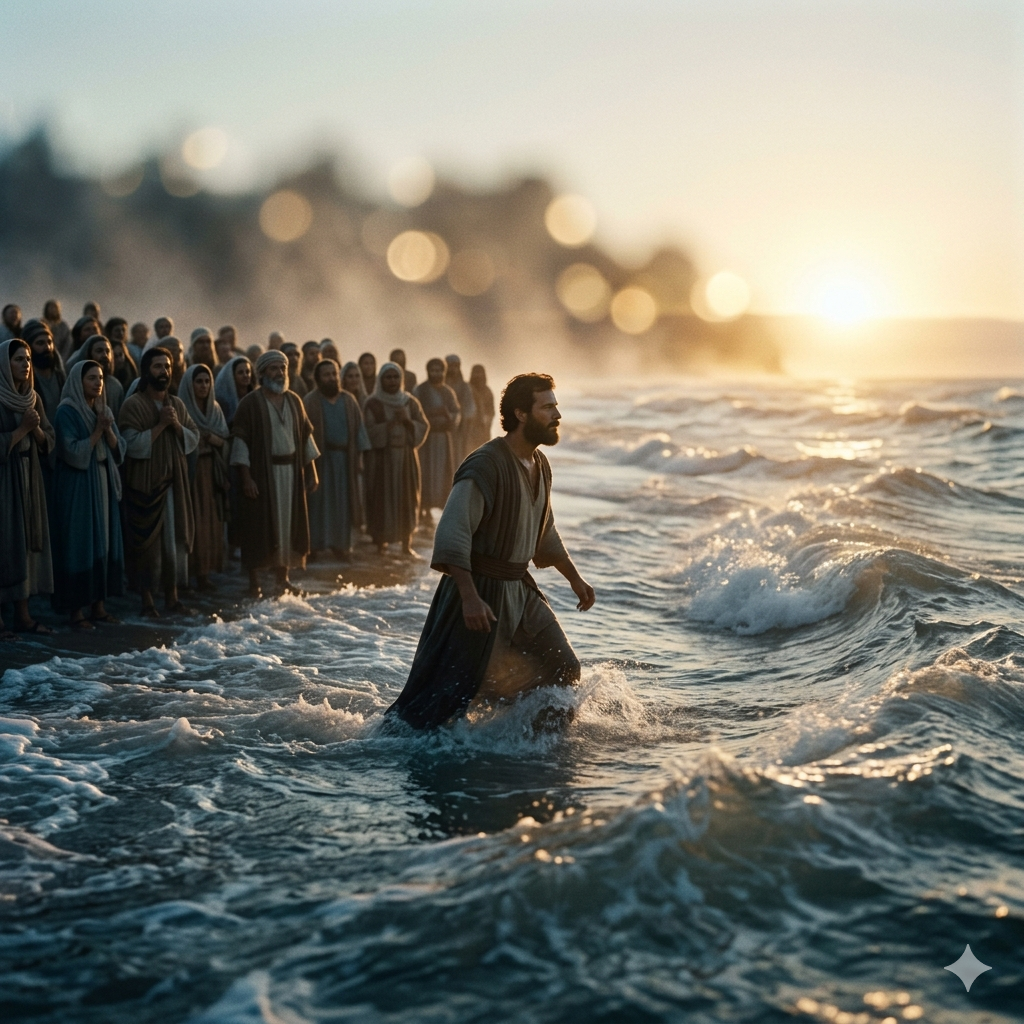
The most dramatic moment comes when the people of Israel stand at the edge of the sea.
The people cry out, Moses prays, and then the divine answer arrives – one of the most unsettling statements in the Torah: "And the Lord said to Moses: Why do you cry out to Me? Speak to the children of Israel, that they go forward" (Exodus 14:15).
On the surface it seems as if the Holy One, blessed be He, is pushing away the prayer, but in depth a fundamental principle is revealed:
There is a stage at which prayer is no longer the right vessel, because the light is already prepared and the flow is already waiting – what is missing is movement on the part of the person.
"That they go forward" is not only a command to walk, but a call to move even when there is no visible path.
This is a state in which a person must enter the water before it splits, act without certainty, and trust that the movement itself will open the way.
Here the great reversal of spiritual reality is revealed: it is not that the path opens first and then we walk; rather, a person walks, and out of the walking the path opens.
Our Sages (Chazal – the rabbis of the Talmud and Midrash) express this idea through the figure of Nachshon ben Aminadav, who walked into the sea until the water reached his neck (literally, up to the throat), and only then did the sea split. Nachshon represents the moment in which a person stops waiting for an external change and is ready to enter the unknown out of faith.
On the Kabbalistic level, this can be understood as an awakening from below – "Mayin Nukvin" (literally "feminine waters," the human initiative that draws down the light from above) – which activates the higher lights. The kindnesses already exist, but they are not revealed until there is a vessel ready to enter the process. Nachshon's act is the creation of that vessel.
From a psychological perspective, this is the moment in which a person moves from a consciousness of control to a consciousness of faith.
As long as a person tries to control reality, to guarantee an outcome, or to avoid the unknown, he remains standing before the sea. But when he is ready to move, even without certainty, a deep change takes place in his inner system.
The nervous system shifts from a state of survival to a state of openness, and the blockage begins to release. The splitting is not the result of a struggle, but of a willingness to pass through the experience. There is a striking image here: the process of a baby who must leave its mother's womb and be born into real life, pushed against its will through a narrow passage, the birth canal, in order to reach the next stage of its development.
The pursuing Egyptians represent those harsh judgments (Dinim) that have not been sweetened.
When the light is revealed, it acts differently on different vessels.
The repaired vessel – the one ready for movement and faith – can pass through the sea on dry land, while the judgments themselves, those old patterns, are nullified and drown. That is why it is said that Israel crossed and the Egyptians drowned in the very same place.
There are not two different worlds here, but two different responses to the same light.
Shavuot, which comes after the Counting of the Omer (the 49 days counted from Passover to Shavuot), is the stage at which the light can finally settle in the vessel. After forty-nine days of work, clarification and repair of the character traits, the vessel becomes fit to receive the "Mochin DeGadlut" (expanded, mature consciousness).
Then comes the Giving of the Torah, which is a union of light and vessel in a stable and lasting way.
If on Passover the light is given from above, and at the Red Sea a person learns to pass through the impossible, then on Shavuot the light already dwells within the person.
From here the deep meaning of the Seventh Day of Passover in a person's life is revealed. It is the place where one must ask oneself where am I still standing before a sea, where am I waiting for reality to change before I move, and where do I know the right step but hold back from taking it for lack of certainty.
The central question is: what is that step a person knows he must take, yet keeps waiting for a miracle before he takes it?
The inner work at this stage is to begin moving even when the path is not yet visible. A person tries to imagine who he would be if the sea had already split for him – how he would think, feel and act – and to begin living from that place right now. This is a passage from passive faith to living faith, from one who asks for change to one who is ready to be a partner in creating it.
The Splitting of the Red Sea teaches that the deepest change does not happen when reality changes first, but when a person changes his relationship to it and is ready to enter it in a new way. It is the moment a person stops waiting for the path to open, steps into it, and discovers through that very step that the path opens before him.
Enjoyed it? ❤️ Share it so others can read it too:
📖 The book in English (Amazon) | 🎥 YouTube | 💬 Daily WhatsApp updates (Hebrew) | 🎧 Spotify | 👍 Facebook | ✍️ Blog
 📖 The book "Path of Living Waters"
The soul is thirsty. The path begins within – clinical psychology and Kabbalah in one language.
About the book, free sample & purchase ▾
Someone says one word, in one tone, and something inside you explodes. Who is really holding the remote control to your buttons?
A journey of healing that unites clinical psychology with the wisdom of Kabbalah and Chassidut – for anyone who feels that pain is a letter from the soul, asking us to return to our source. Written by Ofir Yossef Cohen Touval, clinical psychologist, out of more than three decades of therapeutic work in Israel and Germany.