
By: Ofir Yossef Cohen Touval | Path of Living Waters
Friends, the word "psychosomatic" is made of two Greek words: psyche – soul, and soma – body. But many people hear it almost as an insult: "It's psychosomatic" sounds to them like "It's all in your head," "You're making it up." The truth is exactly the opposite. Psychosomatic pain is completely real pain. The only difference is where it was born.
Maimonides and the movements of the soul
Maimonides, who was a physician before he was a halakhic authority, wrote a medical work called The Regimen of Health. In one of its chapters he explains that the physician must pay attention to the "movements of the soul" – joy, worry, fear, anger – because they change the state of the body. He recommends increasing joy and peace of mind, and warns against worry and sadness, as genuine medical tools.
In other words, more than eight hundred years ago the greatest of Jewish physicians already knew what modern medicine confirms today – that you cannot heal a body without attending to the soul that dwells in it.
A harp with many strings
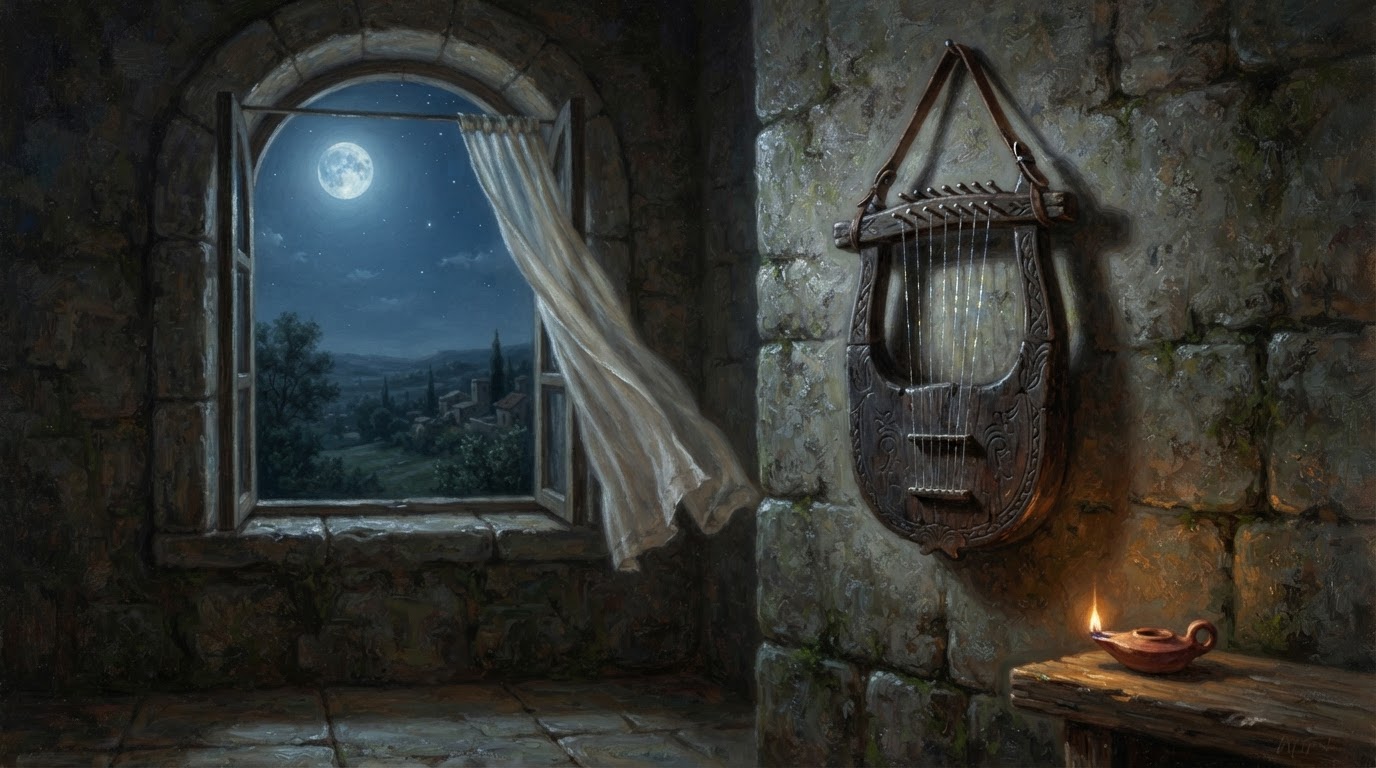
The Talmud tells that a harp hung above King David's bed, and at midnight a north wind would blow on it and it would play by itself (Berakhot 3b). The Kabbalists saw in this harp a symbol of the human being: an instrument with many strings which, when it is tuned, a higher spirit plays upon.
This is exactly the picture of body and soul. When one string is too tight, the whole instrument sounds off. Unresolved emotional tension pulls on the strings in the body: the shoulders, the jaw, the stomach, the breath. And the reverse – a body suffering chronic pain changes mood, patience, and the ability to pray and to love.
How a psychosomatic symptom forms
When a person experiences a strong emotion that has no outlet – fear they may not show, anger with nowhere to be expressed, grief that was not given time – the emotion does not disappear. It looks for another way out. And sometimes the only way left open is the body: headaches, digestive problems, rashes, chronic fatigue, back pain.
In the language of Kabbalah, emotion dwells in the layer of ruach (spirit), whose place is the heart. When the ruach is blocked, it descends into the nefesh – the vital layer that dwells in the blood and the organs. What is not said in the spirit is said in the body.
What happens in psychosomatic therapy
First – rule out a physical cause. Responsible psychosomatic therapy always begins with a medical evaluation. Only after medicine has had its say do we turn to the emotional question.
Listen to the body as a language. When does the symptom appear? What happened before? What does it prevent me from doing – and what does it allow me?
Give the emotion another outlet. When emotion receives words, space and recognition, the body no longer has to carry it alone.
Tune the whole instrument. In the clinic I combine therapeutic conversation with body work, kinesiological assessment and homeopathic guidance – so that all the strings return to harmony.
When the instrument is tuned
Many patients describe the moment of change like this: "Suddenly I understood what my body was trying to tell me." And that moment, when psyche and body begin to speak the same language, is the beginning of deep healing.
And whoever tunes their harp merits, like King David, that the wind from above begins to play upon it too. At the Path of Living Waters clinic this is the work: tuning the instrument, string by string, until it can sing again.
📖 The book in English (Amazon) | 🎥 YouTube | ✍️ Blog

The soul is thirsty. The path begins within.
A journey of healing that unites clinical psychology with the wisdom of Kabbalah and Chassidut – for anyone who feels that pain is a letter from the soul, asking us to return to our source.